
The West Papua Open Day in Docklands on 16th November 2025 was a celebration of our 12th year in the business of winning freedom for West Papua, with two special guests from the Netherlands, one Papua and one Dutch.
1pm Festive lunch prepared by Papuan chef Ivone Bukorpioper
2pm Welcoming Endie van Binsbergen and Sampari Korwa from the Netherlands
2.30 Memorial for our Martyrs and Heroes
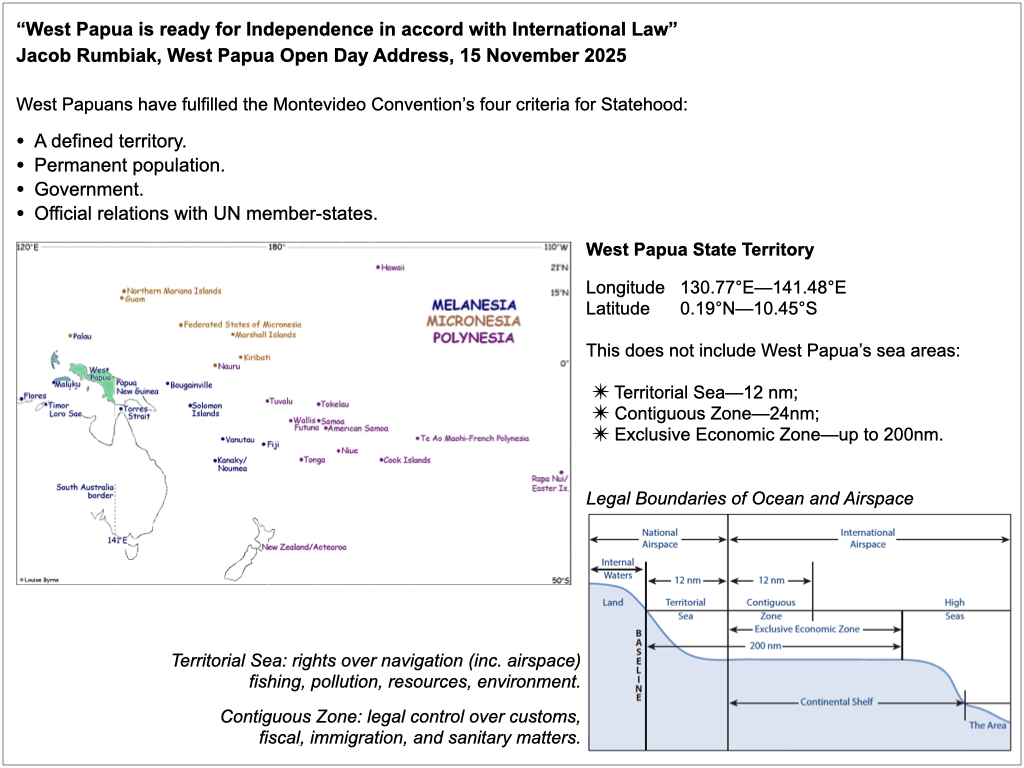
2.45 West Papua is ready for independence in accord with International Law, Dr Jacob Rumbiak
2.55pm Dr Joe’s World Famous Auction for the West Papua Rent Collective
3.15pm Our shop, bustling with new product for Christmas
Two visitors from the Netherlands
ENDIE VAN BINSBERGEN is a respected Dutch activist with years of experience in Lombok (Indonesia) and East Timor, and with Moluccans and West Papuans from the former Dutch East Indies forced to live in exile in The Netherlands. She is the co-author of Eddy Korwa’s memoir De Verstekeling, van Sorong naar Rotterdam published in 2020 by Stichting Vrij Oost Timor; and was instrumental in the English translation The Stowaway, from Sorong to Rotterdam published in 2025 by Stichting Vrij Oost Timor and the West Papua Women’s Office in Docklands.
More on Endie from our launch of The Stowaway on 31 August 2025, at https://dfait.federalrepublicofwestpapua.net/document/wp-open-day-31-aug-2025-launching-the-stowaway/
SAMPARI KORWA is a son of Eddy Korwa, born and raised in The Netherlands in a large warm Papuan family where culture and politics were high priorities. From a young age, Sampari’s parents, Eddy and Sien took him to political protests and demonstrations, and as he grew up he danced and sang in Papuan cultural groups like the Korwari Group. He works at an education institute for adolescents and adults, and at TIFA Magazine where he is cultural programmer of the Pacific Roots Fest that presents the cultures of Melanesia, Polynesia and Micronesia. His wildly popular band, Oceanikz, specialises in Papuan and Moluccan songs.
Biak Wor, a traditional welcome for Endie
https://youtu.be/sba2dRJ5mnw (5-min video)
The West Papuan community in Melbourne welcomed Endie van Binsbergen to the Docklands office with a simple rendition of the traditionally complex ‘Wor’. Wor is “a vocal poetics of shock, of haunting melodies and structured spontaneity, where composer-singers who dance transform surprising encounters into sung texts … It is a form of singing that shows no western influence (Danilyn Rutherford). Yudha Korwa, from Biak Island (one of the 43 West Papuan asylum seekers who arrived in Australia on a traditional canoe in 2006) taught the community as much as he was able to of the very old Biak artform, which of course has its own birth story:
An old man named Mansar Mnuwon was hunting in the forest one night. Suddenly, he heard singing and drumming high in the trees. He scanned the branches for the source of the voices, but found nothing. Whem he sat down under a tall tree to rest, to his surprise, the music swelled. Without thinking, he grabbed a vine which was growing on the tree. The voices suddenly divided into two competing choruses. To the old man’s amazement, the vine’s blossom were singing the song! To keep the voices from returning to the ground when the sun rose, Mansar Mnuwon cut down the vine. He took it home and ate the leaves–and became the first Biak clever at singing wor.” [Danilyn Rutherford, CD notes, Music of Biak: Wor, Church songs, Yospan, Smithsonian Folkways, 1996:p5]
Rutherford: “Like the forest vines which thrive in the island’s rocky soil, wor was once deeply rooted in every corner of Biak life. As they gardened or wove, women sang wor recalling loves ones distant or deceased. Men sang wor at sea to appease the spirits or prepare for battle. Relatives of all ages sang wor at the week-long feasts which marked transitions in the life of a child. The central medium for expressing social identity, wor served to legitimate clan claims to territory; to express demands for gifts of food and drink; to evoke sympathy, support, anger, or sorrow. The expert singer, versed in the subtleties of melody and rhythm, earned fame and fortune for his clever and sudden improvisations, as did the warriors whose praises he sang.”
Notes from ‘Of Birds and Gifts: Reviving Tradition on an Indonesian Frontier’, Danilyn Rutherford, 1996 Biak WOR, Notes, from Danilyn Rutherford 1996.
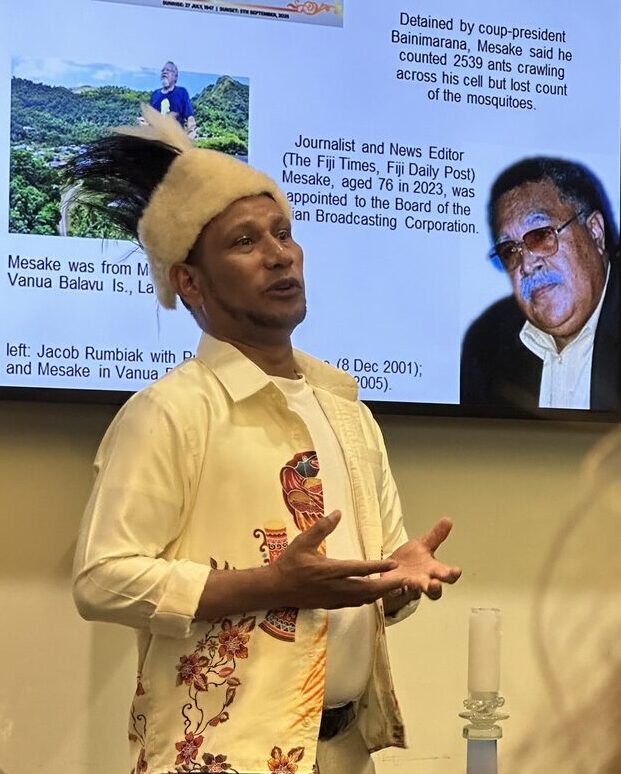
Yuhda Korwa from Biak Island, talking about the Biak Wor, 16 November 2025 (Photo: Heather Smith)
Endie van Binsbergen, West Papua Open Day, 16 November 2025 (Photo: Heather Smith)
Memorial for the Martyrs and Heroes
Honouring the lives and work of three West Papuan activists—Daniel Randongkir, Max Binur, Eddy Korwa—as well as our friend from Fiji, Mr Mesake Koroi.
Daniel Randongkir. Daniel was an anthropologist and a courageous West Papuan activist for a long time. In 1999 he was the student representative on TEAM 100 that travelled to Jakarta to meet President Habibie and demanded independence. He then spent years working with the Papua Peace Network, and with the Papuan human rights organisation EL-SHAM, and testified before the UN Human Rights Council in Geneva. Daniel also spent much of his adult life helping to develop his nation’s independent political structure, and at the time of his death was Head of the Rights and Justice Department in the ULMWP Government.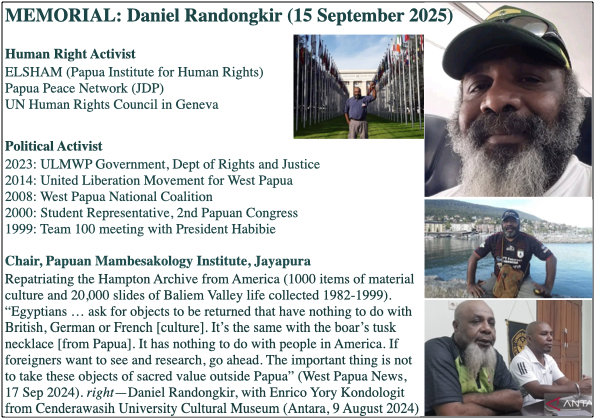
Daniel will be especially missed by Enrico Kondologit from Cenderawasih University’s Cultural Museum, who was working with him on the repatriation of 1,000 items of Dani material culture (and 20,000 photos) taken by American anthropologist OW Hampton between 1982 and 1999. Hampton’s widow’s instructions were for the collection to be returned to Papua. In the meantime Enrico and Daniel (as Chair of the Mambesakology Institute) are having to fight Indonesian claims that this unique assemblage of Dani culture should be housed in Jakarta.
Max Binur. Bright-eyed, big spirited Max Binur died in Sorong, West Papua, on 18 September 2025. Max was an artist, musician and environmental activist who alerted Papuan communities in the Raja Ampat archipelago to the ravages of nickel mining. As he travelled from village to village he taught Papuan youth how to apply ancient tribal principles of sustainability to defend and protect their forest and marine environments from the mining barons, especially those claiming to be philanthropists. He didn’t exclude the Indonesian settlers and transmigrants, but rather fostered their empathy for the injustices West Papuans experience.
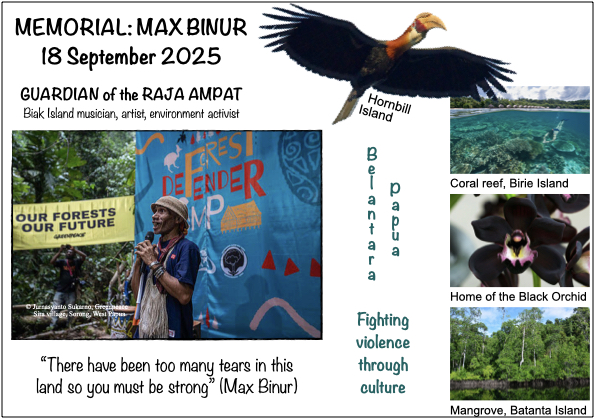
Back in 2003, after the Black Paradise gig in the Concert Hall organised by David Bridie, Max generously left his bass for West Papuans in Melbourne to use. It is now, in 2025, beginning to crack and creak and need specialist attention, but all praise for Max for the seed he left in Australia, and for his devotion to the Raja Ampat islands since. It is our prayerful hope that the hundreds of eco-warriors he inspired and educated gather within West Papua’s Green State policy Framework and somehow save their nation’s extraordinary cultures, land, and seascapes.
Eddy Korwa. Eddy was only 24 when he fled from his homeland, just twelve months after the United Nations transferred the administration of West Papua to Indonesia and he found himself on the Indonesian military’s ‘wanted’ list. In The Netherlands he built a new life and a large family, but never gave up on the struggle for a free West Papua. As a young activist, he joined initiatives within the Papuan community and was soon an inspirational and creative organiser. In his Dutch hometown, Nieuwegein, he co-founded the Papuan Project Group Nieuwegein (PPGN)) which organised fundraisers, peace walks, trips to the UN Human Rights Council in Geneva, Papuan youths in cultural dance groups, and even a tour by a Papuan soccer team to Vanuatu.
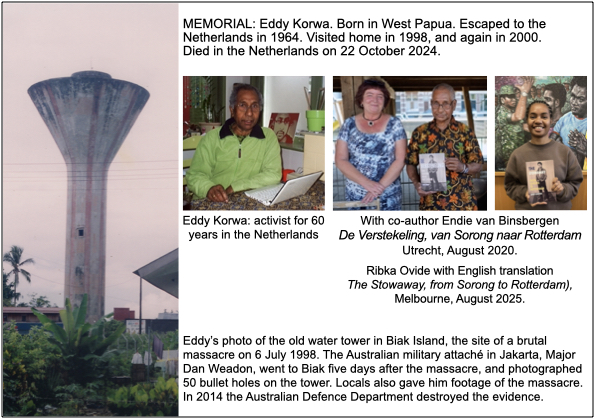
Eddy believed it was important to expand his network beyond the Papuan community, and he established warm relations with the Moluccan community and the Dutch squatters movement, and looked after the East Timorese campaigning in The Netherlands. His work colleagues at the Dutch military base learned to respect him, because of his wit and genuine interest in people’s stories, and his capacity to mediate conflicts without abandoning his own values point of view. In 2013, Eddy’s son Jofrey persuaded him to write his memoir with the assistance of Endie van Binsbergen. It took six years for him to sift though his personal archive and write the book, but the result, De Verstekeling, van Sorong naar Rotterdam published in 2020 was celebrated widely, and is now also available in English (The Stowaway, from Sorong to Rotterdam.
Mesake Koroi. As a journalist in Fiji since 1969, Mesake Koroi saw it all: from colonialism to independence in 1970, successful and less successful decolonising endeavours, democratic initiatives, and Fiji’s notorious coup culture 1987 and 2023. In 2000 Mesake’s family in Melbourne (Dr Robert and Lupe Wolfgramm) alerted him to the issue of West Papua, and for the next twenty-five years he featured the stories of West Papuan activists lobbying in Fiji and introduced them to his state’s politicians and decision-makers. For the Papuans, the former Editor of The Fiji Times and Fiji Daily Post was a pillar of integrity and strength, who offered them his home as a safe space to rest, organize, and strategize. For them, Mesake’s compassion and solidarity was a beacon of support, and his empathy and friendship a source of courage and hope.
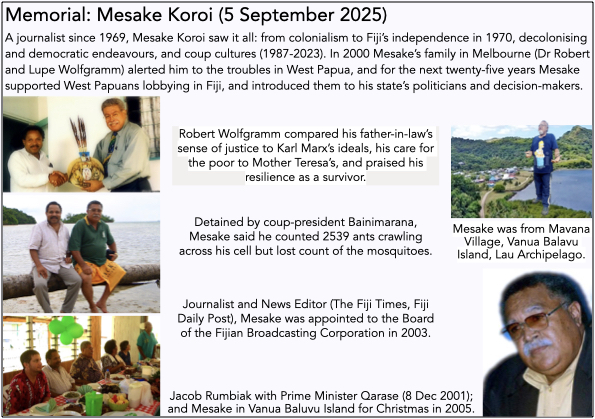
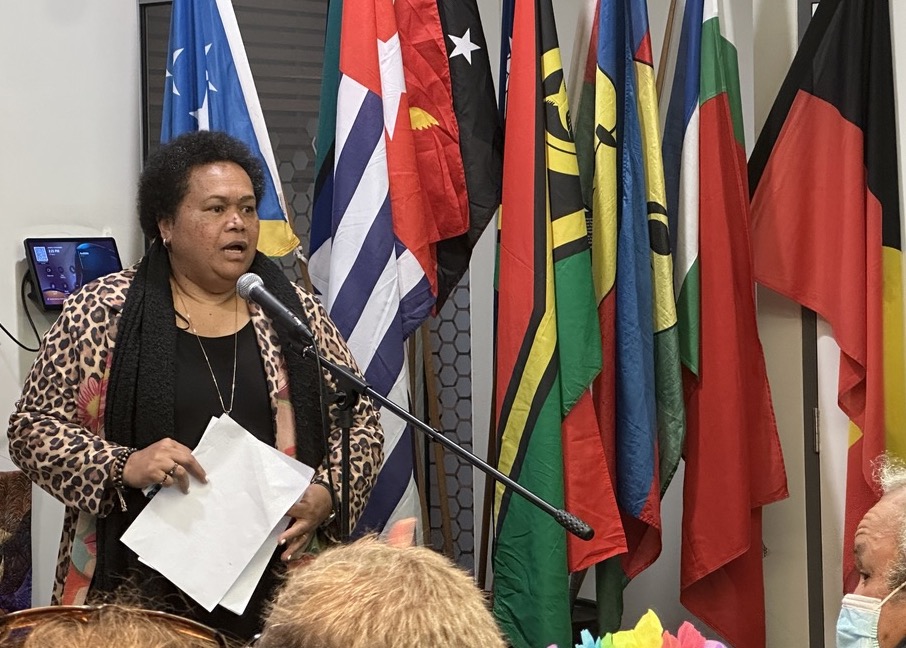
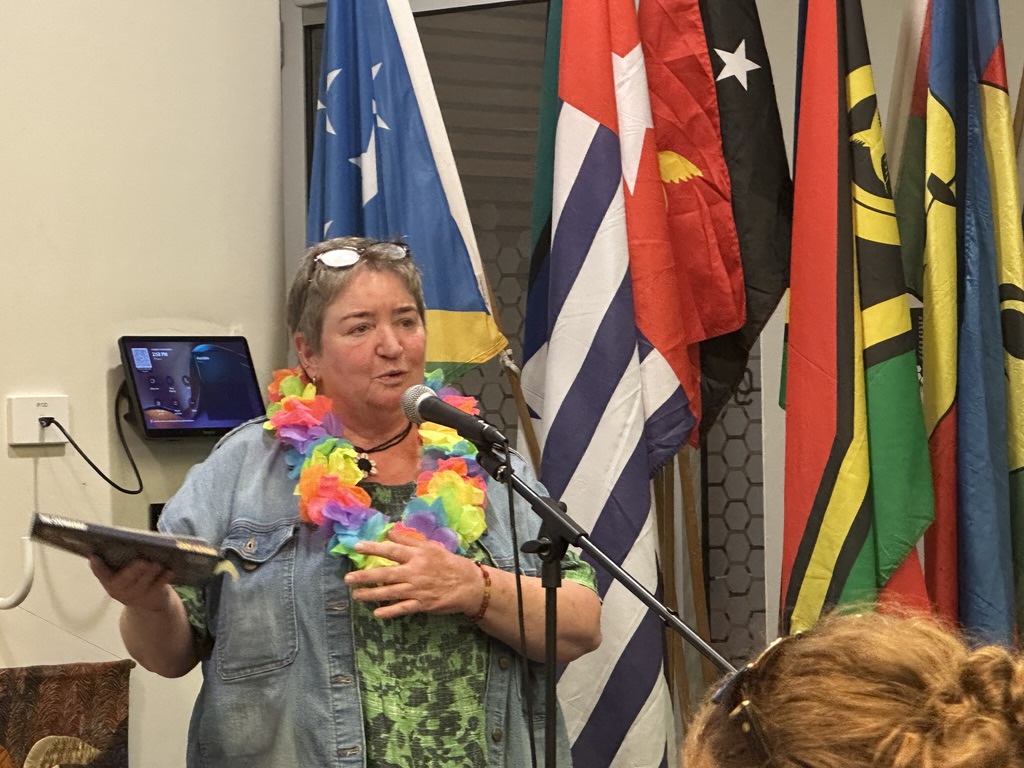
Mesake’s daughter Lupe Wolfgramm, West Papua Open Day, 16 November 2025 (Photo: Heather Smith)
‘West Papua is ready for independence, in accord with International law’, Dr Jacob Rumbiak
https://youtu.be/ANqueg_oo1E (15-min video)
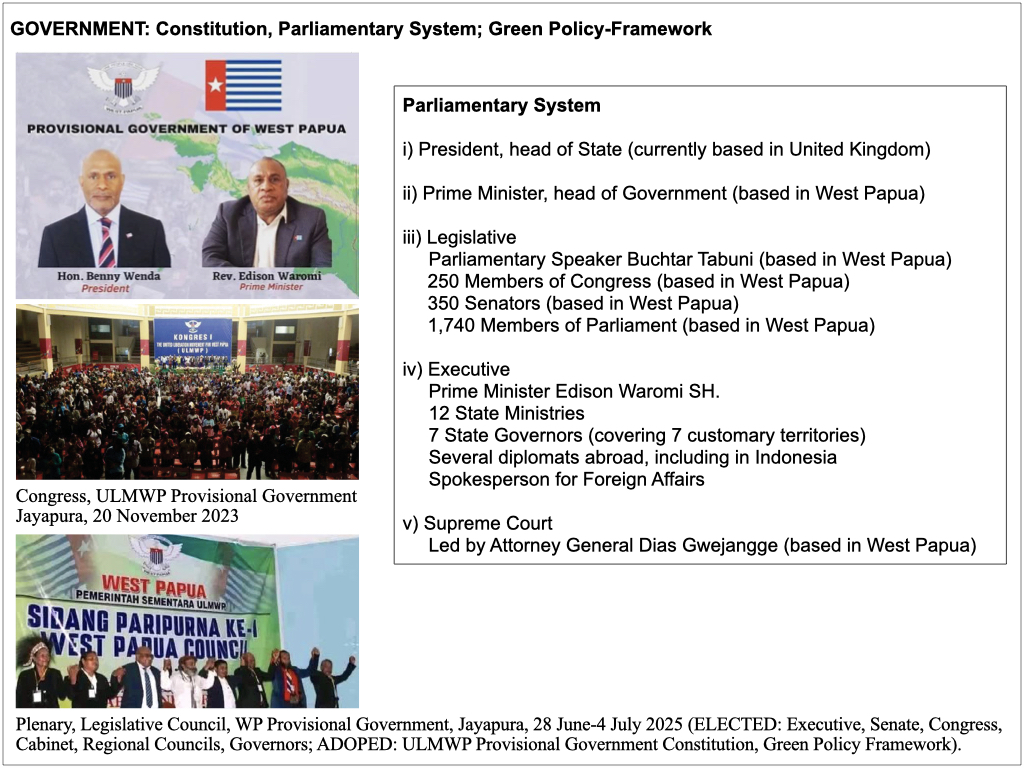
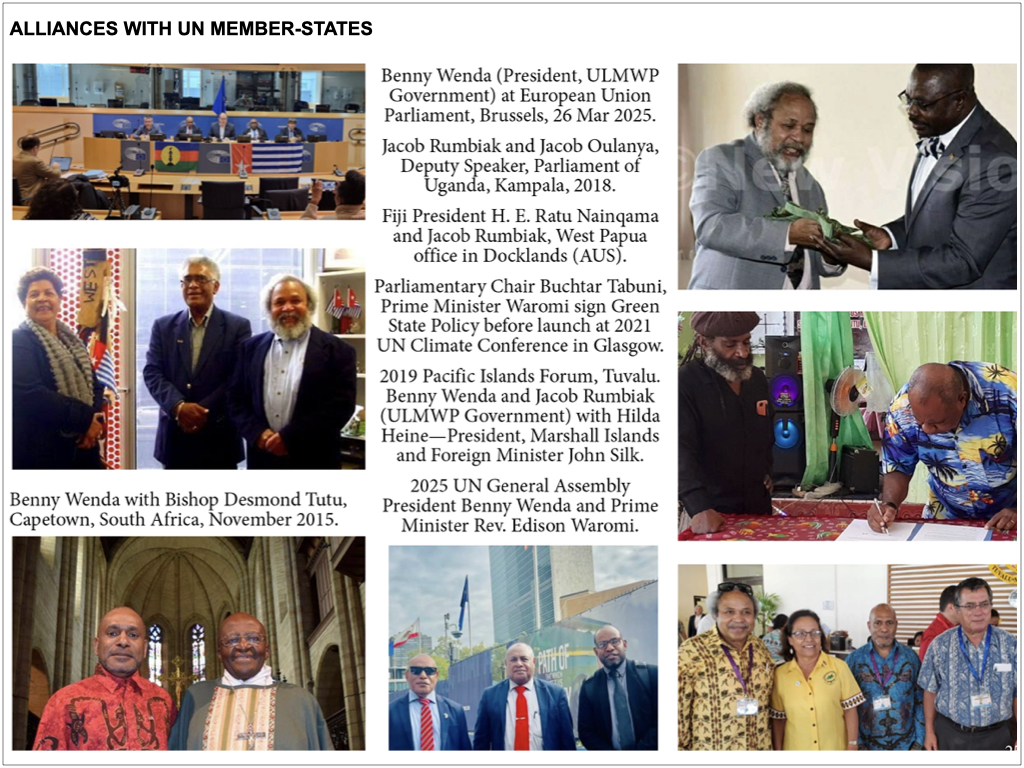
Jacob Rumbiak, Foreign Affairs Minister of the West Papua Government, detailed West Papua’s fulfilment of the four criteria of state formation (Article 1 Montevideo Convention): a defined territory, population, government, and the capacity to enter into relations with other states.
Dr Joe’s World Famous Auction for the WP Rent Collective
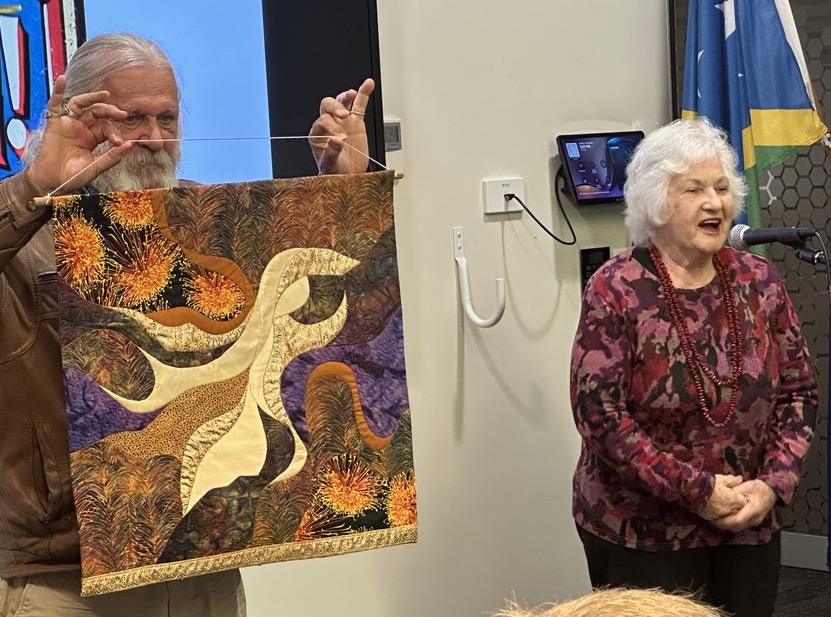
Lois Munro and her beautiful tapestry ‘Hope’, 16 November 2025 (Photo: Heather Smith)
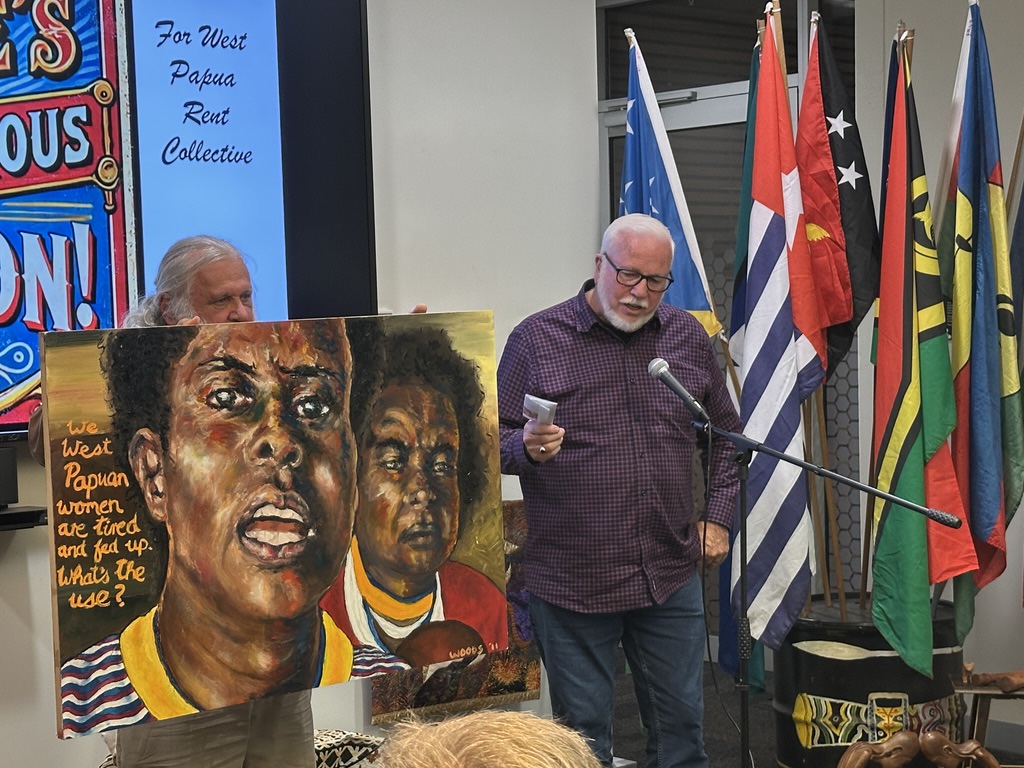
Rev. Peter Woods gifting his painting to the WP Rent Collective, 16 Nov 2025 (Photo: Heather Smith)
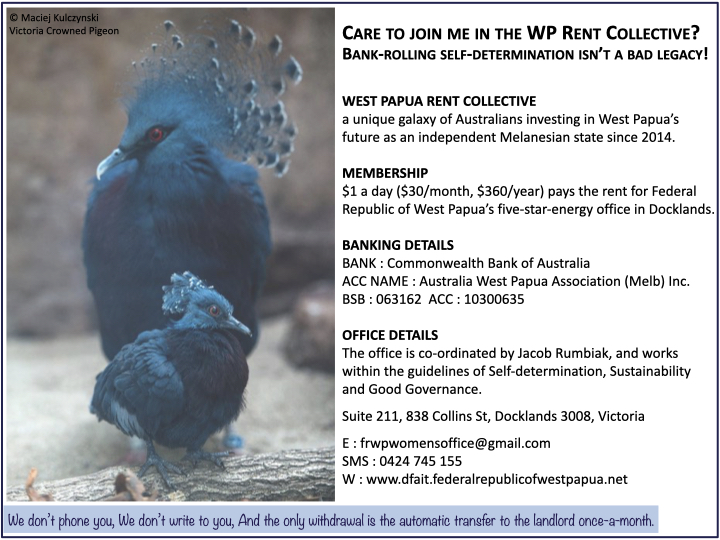
The West Papua Rent Collective
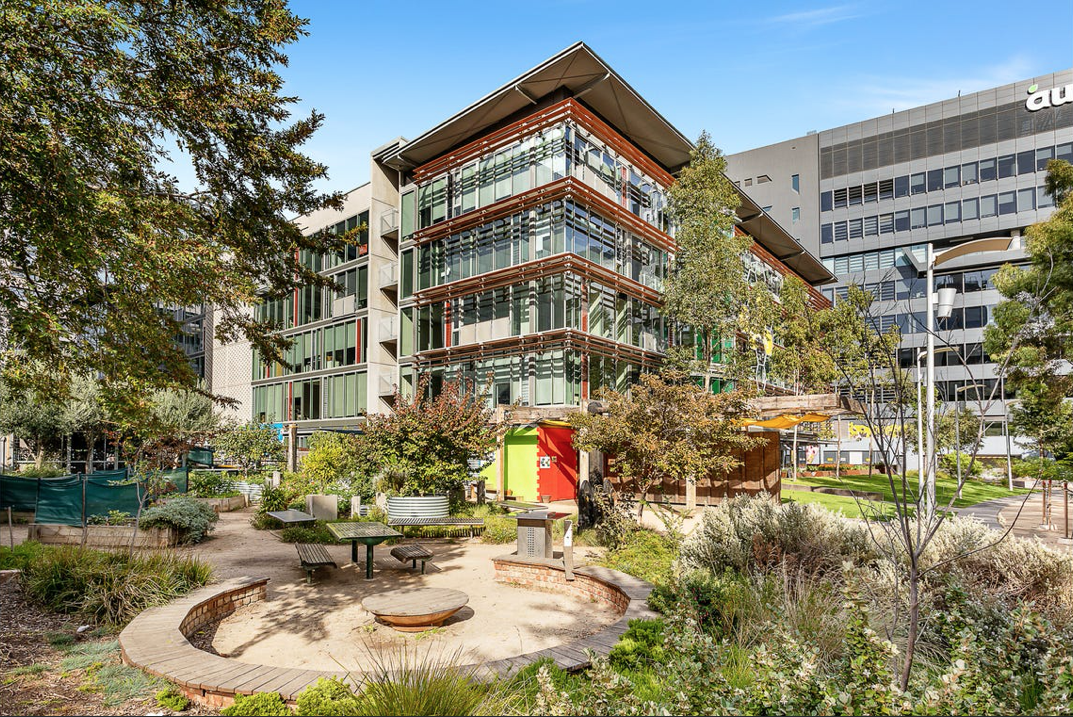
The West Papua Rent Collective is a luminous galaxy of Australians who have been investing in West Papua’s future as an independent Melanesian state since 2014. Members donation of $1 a day ($30/month, $360/year) pays the rent on the Federal Republic of West Papua’s five 5-star energy office at 838 Collins Street in Docklands (Melbourne). The Office, co-ordinated by Jacob Rumbiak (Foreign Affairs Minister, West Papua Transitional Government) works within the parameters of Self-determination, Sustainability and Good Governance.
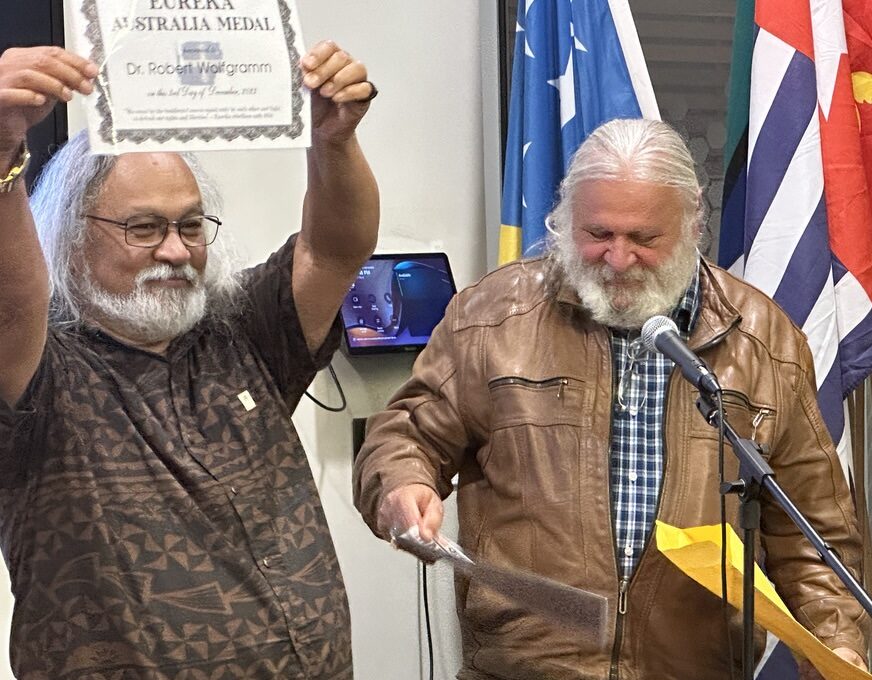
Dr Robert Wolfgramm, receiving his Eureka Australia Medal from Dr Joe Toscano, West Papua Open Day, 16 November 2025 (Photo: Heather Smith)
