
'Solving the Political problem of West Papua by Peaceful means' (5,000 word essay) was prepared by Jacob Rumbiak for the Act of Free Choice Seminar on 15 November 2005 at the Institute for Dutch History in the Royal Library in The Hague. Jacob was then Senior Research Associate as 'a leading scholar on Indonesia and West Papua' at the Globalism Institute, RMIT University in Melbourne, and attended the seminar with another West Papuan leader Benny Wenda who also lives in exile (in Oxford, England). The paper explores the history of Indonesia's occupation of West Papua, including the laws created for Indonesia's 'legal' annexation, and the effect of Indonesia's massacre in 1965-66 of 1-2 million of its own citizens in Java, Sumatra and Bali on the (so-called) vote for integration in West Papua in 1968-1969. (There has never been a referendum in West Papua). The essay is notable for the number of Indonesian sources quoted.The post contains the full essay, as well as a downloadable PDF.

Department of Foreign Affairs Immigration and Trade
Submission to Joint Standing Committee on Foreign Affairs Defence and Trade, 2002
Jacob Rumbiak's “Building a relationship between Australia and Indonesia (that includes West Papua) based on the classic principles of Justice, Peace and Love" was prepared for the Federal Joint Standing Committee's 2002 inquiry of Australia's relationship with the Republic of Indonesia. It consists of well-considered advice from a West Papuan activist who is also an Indonesian-educated academic who escaped from years in prison in 1999. It includes an alarming Papuan Intelligence Service (PIS) report of a meeting between Indonesian President Sukarnoputri, government ministers and military commanders. It discusses fixing government maps to include West Papua as a bona fide nation, giving material aid not financial assistance to Indonesia, education scholarships for West Papuans, and re-consideration of West Papua in terms of security and defence against extremist Islamic organisation. The post contains the 3,400-word essay, and a PDF copy that can be printed/download.
Knowing and understanding how West Papuans were robbed of their independence, April 2000
Paper (6,000 words) by Jacob Rumbiak for 'West Papua at the Crossroads: A conference on the prospects for peace and conflict resolution in West Papua' at the University of Sydney on 19th April 2000. This was the first paper written by Jacob since his escape from jail in Indonesia and flight to Australia, via East Timor (where he was an observer of the referendum) on 7 September 1999. The paper was instrumental in shifting the focus of academic and activists' from the Act of Free Choice in 1969 to the New York Agreement of 1962 (a real politik driven 'peace treaty' that established the infamous 'act-of-no-choice'). The paper was also instrumental in alerting scholars to Indonesia's opportunistic creation and use of election regulations in 1966 (after the coup in Jakarta and the worst massacre in the twentieth century) and political party regulations (PAKET 1-5) drawn up in 1985 to hoodwink the international community into supporting the integration of West Papua into Indonesia.
FRWP to Jakarta International Defence Dialogue, Mar 2012
An Open Letter from the President and Prime Minister of the Federal Republic of West Papua, Forkorus Yaboisembut and the Rev. Edison Waromi to the world leaders attending the Jakarta International Defense Dialogue in 2012. The letter includes a list of fourteen categories of Indonesia's violations of West Papuans human rights; and, in bullet-point form, the colonial context in which they've occurred since the United Nations transferred the administration of West Papua to Indonesia on 1 May 1963.
The Jakarta International Defense Dialogue (2011, 2012, 2013, 2014) was a series of conferences hosted by Indonesia for defense ministers, military leaders, and security experts from around the world (especially the Asia-Pacific) to discuss, build trust, and develop regional security and cooperation, and address emerging defense challenges like maritime security, terrorism, and technological threats. At the conference in 20212 there were 1,500 participants from 37 countries.
Statement by Papuan leaders on trial for treason, 30 Jan 2012
Statement by the five West Papuan 3rd Congress leaders, whose trial for treason began in Jayapura on 30 January 2012. The accused are Forkorus Yaboisembut (President, Federal State of West Papua); Edison G. Waromi SH (Prime Minister, Federal State of West Papua); Agust M. Sananai Kraar (SIP human rights activist/staff); Selpius Bobii (activist/staff); Dominikus Subarat (activist/staff).
Incarcerated West Papuan leader to President Obama, 4 Sept 2012
President Fokorus Yaboisembut writes from Abepura Prison in Jayapura to request President Barack Obama's assistance in negotiating peace and justice with the Unitary Republic of Indonesia.
Indonesia has proved, beyond reasonable doubt, that it has no place in Papua, 15 June 2012
Edison Waromi, Prime Minister of the West Papua resistance government, in a letter form Abepura Prison in Jayapura, criticises Australia in particular for riding on the rhetoric generated by President Yudhoyono and Foreign Minister Natalegawa about Indonesia’s ‘normative’ commitment to dialogue and effort to ‘wage peace aggressively’.
PM Edison Waromi, Reflections from behind Iron Bars, 25 April 2013
A moral appeal on behalf of the Jayapura Five, first published on 25 April 2013, by West Papua Media ()
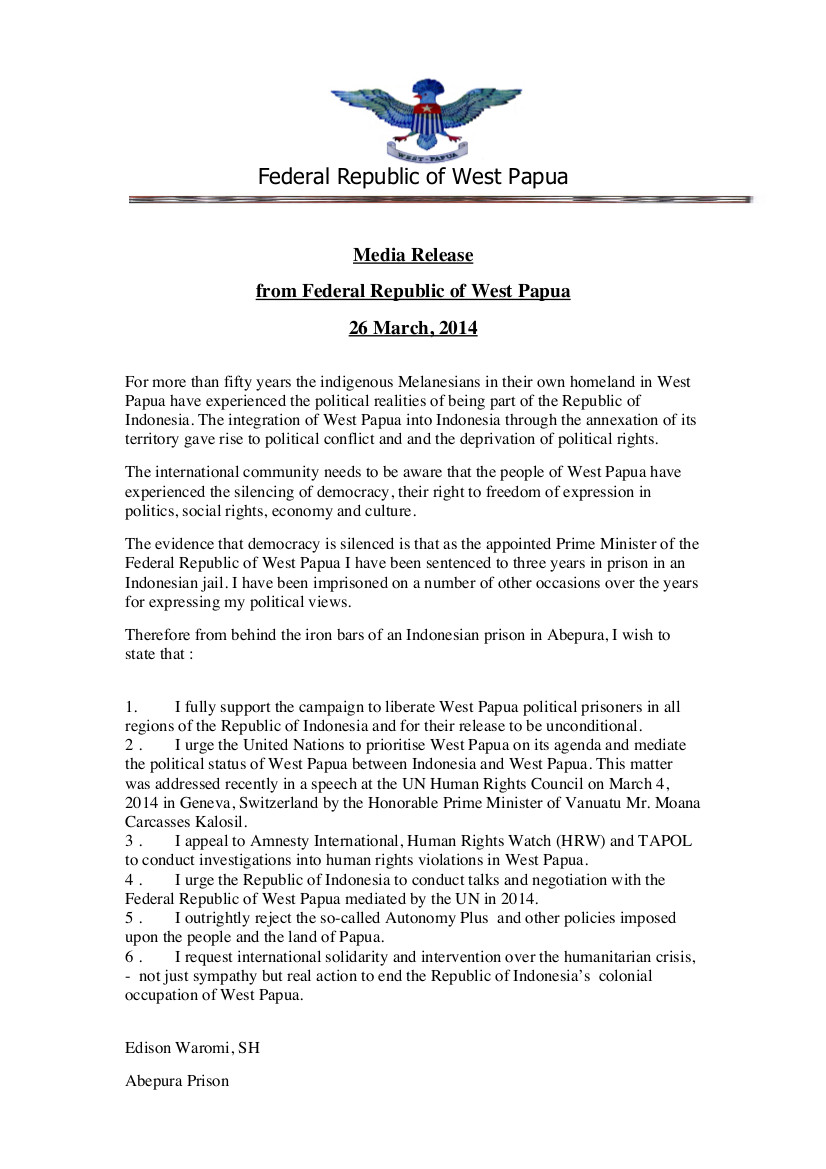
Jailed West Papuan leaders calls for International Support, March 2014
From Abepura Prison in Jayapura, Prime Minister Edison Waromi calls on international support to end the Republic of Indonesia’s colonial occupation of West Papua.

- Live Blog: 2023 December 1 West Papua Independence Day protests and commemorations
- Indonesian Police arrest 4, beat & shoot rubber bullets to disperse Mako Tabuni’s assassination commemoration in Jayapura
- HRD Analysis on Oksibil-West Papua Armed Conflict
- HRD Report: Information on Internally Displaced People in West Papua – Oksibil
- Extension of Special Autonomy Law Number 21 of 2001 for West Papua by Indonesian Parliament: A One-sided Policy implementation
- Permintaan mendesak kepada saksi garis depan dan sumber dari WestPapuaMedia untuk memaksimalkan liputan internasional tentang Darurat Kemanusiaan di Ilaga, Intan Jaya dan Nduga
- Families of TNI victims in Ilaga, Puncak call on Indonesia to stop killing them in open video plea