
 Author:
 Five-thousand word essay by Jacob Rumbiak for the Act of Free Choice Seminar, at the Institute for Dutch History in the Royal Library in The Hague on 15 November 2005. Jacob was then Senior Research Associate (leading scholar on Indonesia and West Papua) at RMIT University’s Globalism Institute (Melbourne) and attended the seminar with another Papuan leader Benny Wenda who lives in exile in Oxford (England).
1. Introduction
On 1 October 1962, the Netherlands Government transferred the administration of the territory of West Papua to the United Nations. Six months later, on 1 May 1963, the administration of the territory was then transferred to the Republic of Indonesia. At the time the Indonesian government claimed it wanted to free Netherlands New Guinea from Dutch colonization, and promised to develop West Papua in all aspects. However, the fundamental rights of the indigenous West Papuans—their human rights, their civil rights, their political rights, their economic rights, and their environmental rights—have been severely compromised since 1962-63. For instance, the Indonesian military has caused the death or disappearance of more than 400,000 West Papuans since 1962-63. An innumerable number of West Papuan women have been raped, and thousands of political activists kidnapped and imprisoned in other parts of Indonesia. In short, the West Papuans have, for forty-two years, been victims of a genocidal terrorist regime that has consciously abrogated its responsibility to develop West Papua, and continues to maintain that the root of its failure is a social rather than a politico-legal issue.
Less than a year after the Indonesian occupation on 1 May 1963, West Papuans established the OPM (Free Papua Organization) to defend their rights, and to counter the effects of Indonesia’s neo-colonial policies and practices. The organization has political, diplomatic, and intelligence wings, and a military wing called the West Papua National Liberation Army.
This paper sets out to establish whether the long-standing conflict between the Indonesian authority and the indigenous people of West Papua has roots in the ‘social’ arena, as the government maintains, or in the politico-legal domain as West Papuans have always asserted.
The paper concludes with suggestions for strategies that need to be recognised and promoted by key actors to combat the human rights abuses and genocidal policies and practices perpetrated by the Indonesian government on the indigenous Melanesians of West Papua.
In writing this paper, I am assuming that:
-
- The Indonesian people and the international community cannot afford to let the conflict between Indonesia and West Papua continue.
- It is possible for two countries to devise a peaceful political solution to a long-standing conflict (Yesaya 43:4, Alkitab, Lembaga Alkitab Indonesia, 1974:793) when there is a commitment to recognise and understand the roots of the conflict.
- The government of a nation is motivated by its peoples need for justice and peace, and therefore endeavours to comply with basic human rights principles.
- The internal harmony of a country can only be maintained if government legislation and practice derives from good intentions and a desire for justice and peace (Pembukaan UUD 1945/Par 4, Preamble to Indonesia’s 1945 Constitution).
- A government is respected by its people when it faces problems and derives solutions for just and harmonious outcomes through peaceful means.
I believe the conflict between Indonesia and West Papua can be solved if the international community promotes processes to deal with it, and the government of the Unitary Republic of Indonesia respects the value of truth, justice, human rights and dignity.
2. Knowing and understanding the roots of the problem
The Indonesian government manipulated historical facts in order to acquire West Papua, especially about relations between Papuans and the Sultanates of Tidore and Ternate, the extent of the Majapahit Empire, and Dutch colonialism in West Papua.
The Sultanates of Tidore and Ternate
When the huge Dutch trading company (Vereenigde Oostindische Compagnie/Dutch East India Company) tried to expand its region of influence to (what is now) North Maluku and West Papua, the Sultan of Tidore claimed rights along the north coast of West Papua. An agreement was reached in 1872, when the Sultan issued trading rights in West Papua to the Royal Kingdom of the Netherlands (which took over VOC holdings after the company collapsed in 1800). In 1945, during discussion about the border of an independent Indonesia, Sukarno’s adviser, Professor Mohammad Yamin, included West Papua, citing ancient hongi relationships between the tiny sultanates of Tidore and Ternate and islands off the north and west coasts of West Papua. The nationalist academic lawyer supplemented his argument with the geological premise that Papua was part of Maluku before the seas rose at the end of the last ice age (Risalah Badan Penyeliduk Usaha Persiapan Kemerdekaan Indonesia (BPUPKI), Panitia Persiapan Kemerdekaan Indonesia (PPKI), 28 Agustus 1945, Sekretariat Negara RI, Jakarta, 1995:50-51).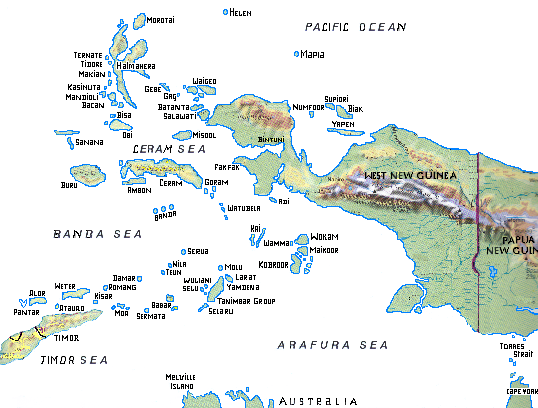
The Majapahit Empire
The Indonesian government also claimed that West Papua was part of the Majapahit Empire based in East Java between the 12th century and 15th century, and that the Hindu-Buddist maritime empire, which was always more concerned with commercial enterprise than territorial aggrandizement, extended from Madagascar Island (Malagasy Republic) off the south-east coast of Africa, to Pass Island off the west coast of Chile.The Dutch East Indies
Towards the end of World War Two, during negotiations with the Japanese military, Sukarno’s adviser, Professor Yamin, proposed that West Papua be included in the Indonesian Republic (Risalah Badan Penyeliduk Usaha Persiapan Kemerdekaan Indonesia (BPUPKI), Panitia Persiapan Kemerdekaan Indonesia (PPKI), 28 Agustus 1945, Sekretariat Negara RI, Jakarta, 1995:51). On 22 March 1963, three weeks after the UN handed the administration of West Papua to Indonesia, President Sukarno proclaimed “Irian Barat was together with the Indonesian red and white flag six thousand years ago” (Buatlah irian barat satu zamrud yang indah, Departemen Penerangan RI, 1964:265-66).The Linggarjati and Renville Agreements
On 15 November 1946, a year after Sukarno proclaimed the independent republic of Indonesia, a delegation of Dutch officials met members of the independence movement in Linggarjati, in the regency of Kuningan in West Java. The meeting was to discuss Indonesia’s demand for Dutch recognition of the Republic of Indonesia which Sukarno had proclaimed on 17 August 1945 and the consequent transfer of all Dutch-Indies territory, including Dutch Nieuw Guinea. The Dutch authority rejected both demands, but agreed to meet again in Jakarta on 25 March 1947 to sign the Linggarjati Agreement. Article 1 of the Linggarjari Agreement stipulated that the Royal Kingdom of Netherlands government recognize the de facto reality of the Indonesian State consisting of Java, Madura and Sumatera. Article 2 stipulated that the Dutch government and the young Indonesian government work together to build a dignified state, based on the principle of democracy, in the form of a federation (RIS).Privately, however, Indonesia’s political elite decided that Articles 1 and 2 of the Linggarjati Agreement contravened its BPUPKI (National Investigation in Preparation for Indonesia’s Independence) and the recommendation made by PPKI (Committee Preparing for Indonesia’s Independence) which was “the territory of Indonesia is Sumatera, Malaya (now Malaysia), Borneo (now Kalimantan), Java, Celebes (now Sulawesi), Sunda Kecil, Maluku, and New Guinea” (Risalah Badan Penyelidik Usaha Persiapan Kemerdekaan Indonesia (BPUPKI), Panitia Persiapan Kemerdekaan Indonesia (PPKI), 28 Agustus 1945, Sekretariat Negara RI, Jakarta, 1995:48). Indonesia therefore declared war on the Netherlands. The UN Security Council passed a resolution urging the combatants to desist, and the UN Commission for Indonesia set up a Commission of Three States (Komisi Tiga Negara) to broker talks. The three states, Australia (nominated by Indonesia), Belgium (nominated by the Netherlands) and the United States of America (nominated by Australia and Belgium) brought about the Renville Agreement.
The Renville Agreement was signed on the Dutch warship Renville on 14 January 1948. Like its predecessor, the Linggarjati Agreement, it concluded that “dignity would be maintained by using democratic principles to develop a federation and a constitution”. Indonesia considered the Renville Agreement a disaster, and a few months later declared war on the Dutch again. International pressure eventually brought both parties to a UN-sponsored Round Table Conference in Den-Haag, and on 27 December 1949, the Netherlands transferred sovereignty of the Dutch East Indies, from Sumatra to Ambon, to the Federal United States of Indonesia. Both parties agreed to negotiate the status of Nederlands New Guinea over the next twelve months (Pasal 2, Piagam Penyerahan Kedaulatan, Konferensi Meja Bundar 1949). However, by 27 December 1950, no agreement had been reached, in part because by May 1950 Sukarno had supplanted the Federal Republic with a ‘Unitary Republic of Indonesia’, whose application for membership had been accepted by the United Nations in September 1950.
Uti Possidetis
Indonesia consistently called on the legal principle of Uti Possidetis, whereby emerging States that had been colonies inherited colonial borders. However, uti possidetis was not consistently used in the break-up of (colonial) States, or in treaties, and in fact was just one of a variety of ways of delimiting a boundary. Uti possidetis is in fact a pragmatic confused device, which, because of its inconsistent use, has never become part of customary international law (Annette Culley, 2016 West Papua: Decolonization, Boundaries and Self Determination; A summary of modern West Papu’s legal history and future prospects, West Papua Women’s Office, Federal Republic of West Papua).The United Nations
Indonesia tried, but failed four times (1954, 1955, 1956, 1957) to have its claim of sovereignty over West Papua recognised by the United Nations. (The 1957 motion was considered by the First Committee at eight meetings but still did not secure a two-thirds majority!). After the 1957 failure, President Sukarno appointed Dr. Soebandrio, former Minister of Foreign Affairs and Director of Indonesian National Intelligence, to lead a munitions-buying delegation to Moscow. 15 ADRI warships, 30 Tupolev aeroplanes, and six submarines were acquired. The buying spree continued (a cruiser, 8 anti-submarine patrol vessels, 20 missile boats, several motor torpedo boats, gunboats, armored and amphibious vehicles, helicopters and bombers). By 1961 Indonesia was the most powerful military power in Asia outside China. In 1962 there were 3,000 Russian troops in Jakarta wearing Indonesian military uniforms and carrying Indonesian identity cards (Aleksej Drugov, Genadi Melkov, Volskran, Netherlands, 10-13 Feb 1999. Melkov was Commander of Russian Army in Jakarta in 1962. Drugov was his interpreter).In the meantime, West New Guinea, a UN Non-Self-Governing Territory since 1950, continued developing under Dutch Administration within the parameters of self-determination. On 5 April 1961, the Nieuw Guinea Peoples Representative Assembly (Nieuw Guinea RAAD) was launched. The RAAD was a unicameral body with eighty percent indigenous membership. It shared responsibility for framing legislation and the budget with the governor and departmental heads. Members held rights of petition, interpellation, amendment, and parliamentary immunity. Its prime responsibility was preparing the decolonisation program.
The RAAD legislated the Papuan State extended from 1 deg 19 min North—10 deg 45 min South, and from 128 deg 45 min—141 deg 48 min West, with the Pacific Ocean marking the north border, the Arafura Sea the southern border, the Halmahera and Ceram seas the western border. The eastern border was the Non-Self-Governing Territory of Papua and New Guinea, administered by Australia. In October 1961 it legislated the emerging state would identify with the Morning Star flag, an anthem (‘Hai tanah ku Papua’/Papua is my homeland), an emblem (Victoria Crowned Pigeon/Goura victoria), a motto (‘One people, one soul’), and a coat of arms. On 1 December 1961, in ceremonies across the territory, the Morning Star flag was raised alongside the Netherlands flag, the two national anthems were played, and the Papua Volunteer Korp (PVK) marched alongside the Netherlands Army. Eighteen days later, on 19 December, President Sukarno ordered the Indonesian military to prepare for a full-scale military invasion.
3. Laws created for Indonesia’s ‘legal’ annexation
The New York Agreement, 1962
Indonesia’s continuing military incursions, bolstered by Soviet military training and arsenal, alarmed and galvanised the United States. After the UN General Assembly refused to recognize West Papua’s right to self-determination in November 1961, the Kennedy administration forced the Netherlands to transfer administration of the UN Non-Self-Governing Territory to the Unitary Republic of Indonesia via an UN ‘peace treaty’. In an attempt to stamp the transfer legitimate in terms of international law, the New York Agreement was tied, via Article 1, to a UN resolution, which was passed five weeks later, on 21 September 1962. UNGA Res. 1752 (XVII)) approved UN control over the transfer despite no consultation with West Papuans, meaning, ultimately, that Indonesia was able to distend its republic with 421,981 square kilometres of traditional Melanesian land.
Melanesian Papuans claim the Agreement was simply an opening for the evil politics of colonisation. They were not consulted during the drafting process, were not present when it was signed on 15 August 1962, nor when it was sheeted through the UN General Assembly on 21 September 1962. Article V11 allowed for the presence and employment of Indonesian soldiers already in West Papua (on incursions up to the day the Agreement was signed) during the UN’s six-month administration of the transfer between 21 September 1962 and 1 May 1963. Article XIV stipulated that after the transfer on 1 May 1963, Indonesia could enact new laws and regulations, which it did immediately with three Presidential Decrees: the first closed West Papua to the international community, the second classified West Papua an operational military zone (Daerah operasi militer), the third (No. 11/PNPS/1963) re-activated an old Dutch subversion law. Most of the UN experts, designated by Article XV1 to remain in West Papua to help prepare the people for the act-of-free-choice, left the day after the transfer. Article XX provided for an ‘act of self-determination’, but gave Papuans the choice of ‘remaining with Indonesia’, or ‘severing ties with Indonesia’ rather than the proper legal choice between independence, integration, or free association with another state.
Indonesian regulations, 1966
The 1966 election regulations formed the basis of Suharto’s authoritarian military regime, from 1966 after he deposed President Sukarno, until he himself was overthrown in 1998. The regulations required voters to state their loyalty to the government, the Indonesian Constitution, and Pancasila (the state ideology: belief in God Almighty, in a just and civilized humanity, the unity of Indonesia, democracy guided by the wisdom of representative deliberation, and social justice for all Indonesians). The military that managed New Order Indonesia manipulated these laws to incriminate communists, muslims; and in West Papua–where, for example, ‘democracy guided by the wisdom of representative deliberation’ was used to white ant the ‘act of self-determination to be carried out in accordance with international practice’ (New York Agreement, 1962).
Major-General Suharto’s foray into West Papua was by appointment of President Sukarno on 19 December 1961, to “overthrow the puppet government in Dutch New Guinea, raise the Indonesian flag, and implement Indonesia’s authority”. (The ‘puppet government’ being the New Guinea RAAD (nascent parliament) in the UN Non-Self-Governing Territory). His fastidious war plans (with USSR but also USA military hardware and training) were necessarily downgraded (to continuing small-scale military incursions) after the JF Kennedy administration converted Sukarno’s bellicose commands to a duplicitous United Nations-sponsored ‘peace’ treaty that transferred administration of the Non-Self-Governing Territory from the Netherlands to Indonesia (until an act of self determination). It was a machiavellian move: the Papuan indigenous owners of the territory, were not consulted; and Indonesia, the Administrating Power was able to use its own regulations to control civil, cultural, political and economic life; even, in 1967 issuing Freeport, an American mining corporation, exploring and extraction rights (+ generous tax exemptions) on Amungme tribal land.
West Papuans understood they were as vulnerable to mass murder as the Indonesian Muslims, Chinese, and Communists were in 1965-1966 when Indonesia butchered 1-2 million of its own citizens in Java, Sumatra and Bali. That purge was described by the CIA (which helped facilitiate it) as “one of the worst mass murders of the 20th century, along with the Soviet purges of the 1930s, the Nazi mass murders during the Second World War, and the Maoist bloodbath of the early 1950s”. Two years later, Suharto sent the manager of the purge, Brigadier-General Sarwo Edhie Prabowo, to West Papua to lead the Indonesian Army during the act-of-free-choice (the vote that wasn’t a referendum). Article XVIII of the New York Agreement hyad allowed for ‘Consultations (musjuwarah) with representative councils on procedures and appropriate methods’. Indonesia interpreted this to mean military officers selecting 1026 Papuans (0.01% of the population), isolating them for six weeks, assembling groups of them in eight different locations, in front of military officers, and told to raise their hand if they supported integration with Indonesia.
PAKET 5 political regulations, 1985
Paket 5 (UU Parpol 1985) was a body of political laws presented as ‘parliamentary reforms’ but designed to institutionalise New Order structures and control, ensure the supremacy of Pancasila, suppress political dissent, and discipline social organisations.
PAKET 1: Regulation No. 1/1985 tightened New Order control over national and regional electoral processes.
PAKET 2: Regulation No. 2/1985 solidified the military’s political role in the People’s Consultative Council, Legislative Assembly, and Provincial Assemblies. These bodies made the government appear representative, when, in fact, the government pre-determined appointments to them, including of West Papuans, which divided families and clans over support for the resistance.
PAKET 3: Regulation No. 3/1985 embedded the position of Indonesia’s three official political parties: the United Development Party (PPP), Indonesian Democracy Party (PDI); and the Golkar Party for civil servants. It outlawed any party formed by West Papuans as subversive (‘makar’ is a serious crime in Indonesia).
PAKET 4: Regulation No. 5/1985 among other restrictions, legislated that the referendum system was not known, or valid, in Indonesia. This protected Indonesia against allegations that the act-of-free-choice was fraudulent, and against any attempts by West Papuans to agitate for another.
PAKET 5: Regulation No. 8/1985 was a list of restrictions for all social and mass organizations, including that they adopt, as their sole foundation, the state ideology of Pancasila. This obviously led to the suppression of indigenous Papuan cultures, languages, and traditional practices.
Implementing the act-of-free-choice, 1968-1969
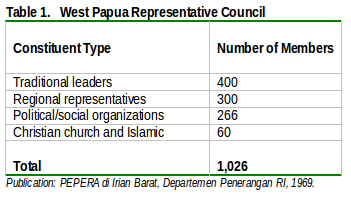
Citing the duplicitous New York Agreement and its own government regulations, the Indonesian military selected 1,026 West Papuans to participate in the act-of-free-choice: four hundred traditional leaders, three hundred regional representatives, two hundred and sixty-six representatives of political and social organizations, sixty Christian church and Islamic representative (Table 1).
Assembling the Population to Vote
Indonesia created counterfeit democratic conditions by appointing representatives from the eight regencies to ‘vote’. So 175 represented 141,373 Papuans in Merauke (0.12%); 175 represented 165,000 Papuans in Jayawijaya (0.10%); 175 represented 156,000 Papuans in Paniai/Nabire (0.11%); 75 represented 38,917 Papuans in Fak-Fak (0.19%) from Fak-Fak; 110 represented 86,840 Papuans from Sorong (0.12%); 75 represented 53,290 Papuans in Manokwari (0.14%); 131 represented 93,230 Papuans in Cenderawasih regency (0.14%); 110 represented 81,246 Papuans in Jayapura (0.13%). The Melanesian population in 1969 was 816,896.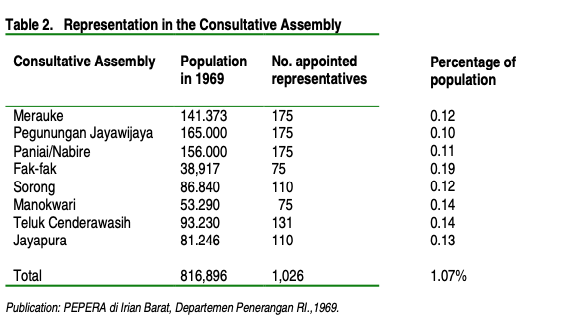
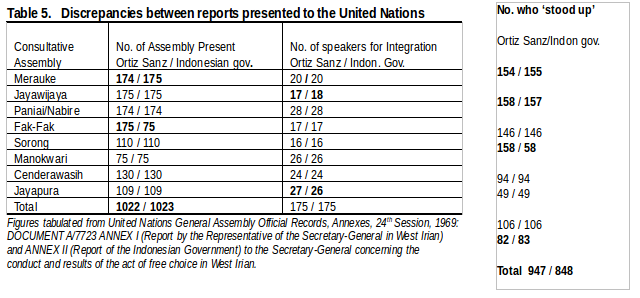
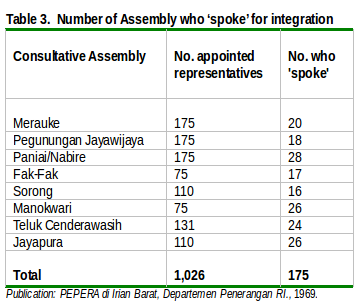
The voting ‘style’ demanded by Indonesia for the act-of-free-choice, and accepted by the United Nations, was musjuwarah. Several Papuans in each Assembly were told to stand up, were asked by the Indonesian military officer if they wanted to ‘stay with Indonesia’, and then required to proclaim the Republic of Indonesia from Sabang to Merauke, its constitution, its flag, and its government. Then the rest of the assembled were told to stand if they agreed. Of the 175 Papuans in the Merauke Assembly, only twenty spoke for integration; of the 175 in Jayawijaya, eighteen spoke; of the 175 in Paniai/Nabire, twenty-eight spoke; of the 75 in Fak-Fak, seventeen spoke; of the 110 in the Sorong Assembly, sixteen spoke; of the 75 in Manokwari, twenty-six spoke; of the 131 in Cenderawasih, twenty-four spoke; of the 110 in the Jayapura Assembly, twenty-six spoke. Table 3 shows that of the 1,026 Papuans appointed to vote, only 175 ‘spoke for’ integration. The other 851 merely stood up when asked by the Indonesian military officer if they agreed.
The ‘time factor’ in the act-of-free-choice
For East Timor’s referendum, the agreement signed by Indonesia, Portugal and the UN on 5 May 1999, stipulated the ballot take place on one day (30 August 1999). This internationally-recognized practice helped to foil the Indonesian plans to subvert and manipulate the process. Compare that with the act-of-free-choice in West Papua which took place over nineteen days, from 14 July to 2nd August 1960.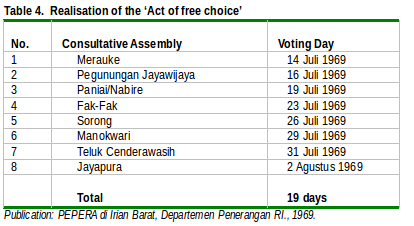
Discrepancies between two reports presented to the United Nations
There are discrepancies about the number of Papuans who ‘voted’ in the act-of-free-choice between the reports presented to the UN General Assembly by the Indonesian government and the Secretary-General’s Representative Ortiz Sanz.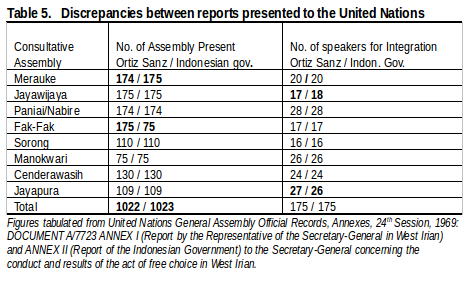
4. Correcting the historical record
West Papuan relations with the Sultanate of Tidore
In 1660, the Sultan of Tidore told the Dutch East Indies Company (VOC) that West Papua territory was under his control (Lagerberg, K West Irian and Jakarta Imperialism, London, Hurst, 1979:16). Four centuries later, President Sukarno, in his quest to colonise Netherlands New Guinea, repeated the Sultan’s claim, ignoring the fact that in 1679 the Dutch governor of Banda Island, Mr Keyts, suggested that the Sultan’s claims should not be taken seriously. Sukarno also ignored public statements by Captain Thomas Forrest in 1775, and the Dutch governor of Ternate in 1778, that the Sultan of Tidore had no power in West Papua and no claim over the territory (ibid). Sukarno also ignored the writings of Dr Freerk Kamma, a Dutch priest and anthropologist who worked and studied in West Papua, who claimed that the Biak-Numfoor warrior hero, Kurabesi, married the Sultan of Tidore’s daughter, and that such a marriage could only have resulted from a successful invasion by Kurabesi of the Sultan’s territory. (Some Biak-Numfoor people, like my mother, still have land in Tunuwo in Ternate-Tidore).
West Papua was never a part of the Majapahit Empire
With its headquarters in East Java, the Majapahit Empire (1292-1478) included two thirds of Java Island, a small part of South Borneo and of South Celebes, Bali, the Lesser Sundas and Central Moluccas. There is no evidence that the Majapahit conquered any area of New Guinea; and despite the claims in all Indonesian documents, including current school curricula, it did not include Madagascar off the south-east coast of Africa, or Pass which they claim is off the coast of Chili.
West Papua not automatically part of the Indonesian Republic
Although Indonesian politicians in the 1950s and 1960s claimed West Papua (as part of the Netherlands colonial realm, and the Dutch East Indies in particular) they never referenced other Dutch colonies with a history of slaving, like Dutch Guiana in South America (independent Suriname since 1975), or Caribbean islands like Aruba (a constituent country of the Kingdom of the Netherlands since 1986), or Curaçao and Sint Maarten (constituent countries of the Kingdom of the Netherlands since 2010).
‘Indonesians’ under the Dutch were slaves for hundreds of years, and prepared to engage in violent warfare to advance their independence aspirations. West Papuans, however, were barely touched by Dutch traders and military. They were influenced, after 1855, by Dutch and European Protestants with welfare and education practices embedded in their missions. The early, and continuing influence of Christian nuns, priests, pastors, and brothers means West Papuans think and behave very differently to regular Indonesians who constitute the biggest Muslim nation in the world.
West Papuans not included in the structuring of the Indonesian state
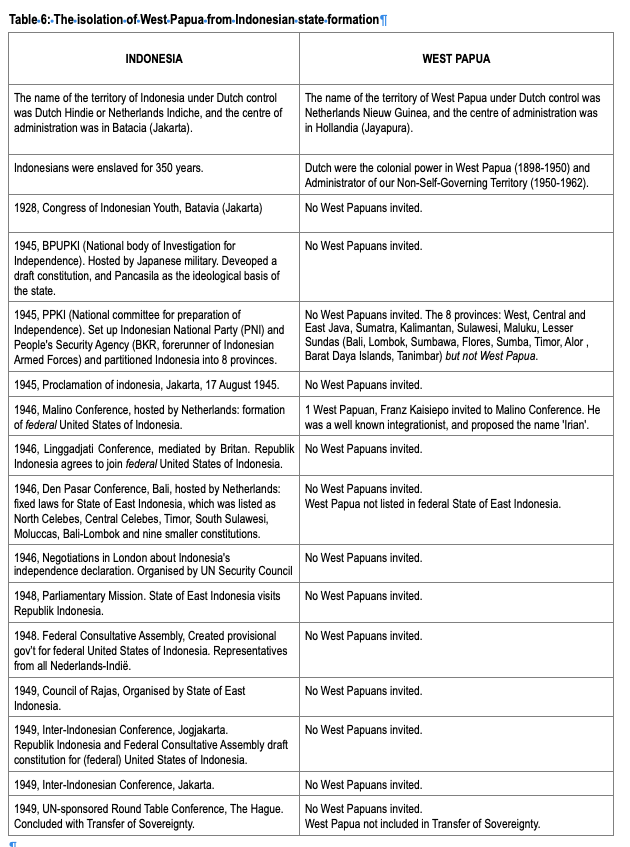
Given President Sukarno’s obsession with winning sovereignty over West Papua, it is striking how isolated West Papuans were from the development of the Indonesian state between 1945 and 1949. No West Papuans were invited to any resistance, nation-making, or peace meetings whether hosted by Republik Indonesia, Netherlands Government, Federal Consultative Assembly, or even the United Nations.
5. Crimes against humanity in occupied West Papua
Indonesia was poised to invade West Papua in 1961, with its own military power as well as Russian soldiers, military trainers and advisers, arms and war machinery. West Papuans believe that this, in addition to several questionable legalities in the New York Agreement, and the violent abuse of their political, human and economic rights since 1963, constitute reason enough for a list of Indonesian presidents to face the International Criminal Tribunal at the Hague. International legal experts and human rights organizations include in their allegations state-sponsored violence, racial discrimination, the suppression of self-determination, extrajudicial killings, systematic torture, disappearances, and a campaign of violence against the indigenous population.
6. Peaceful solution of the political conflict
The political conflict in West Papua can be resolved peacefully when those involved in the transfer of West Papua to Indonesia (the UN, the USA, the Netherlands and Indonesian governments) take responsibility for solving the problem in terms of:
- Insisting on the withdrawal of the Indonesian military from West Papua
- Facilitating independence and self-determination talks between Indonesia and West Papua under the auspices of a third party
7. References
Ahmed Ali and Crocombe RG 1982
Politics in Melanesia, Institute of Pacific Studies, University of South Pacific, Suva, Fiji.Alkitab, Lembaga Alkitab Indonesia 1974, Ciluar Bogor, Indonesia
Alua A. Agus 2002
Dialog nasional Papua dan Indonesia, Kembalikan Kedaulatan Papua Barat, Pulang dan Renungkan Dulu, Seri Pendidikan Politik Papua No. 2, 26 Februari 1999, Penerbit Sekretariat Presidium Dewan Papua dan Biro Penelitian STFT Jajar Timur Jayapura.Alua A. Agus 2000
Mubes Papua 2000, 23-26 Februari, Jalan Sejarah, Jalan Kebenaran, Seri Pendidikan Politik Papua No. 3.Budiardjo, Carmel and Liem Soei Liong, 1988
West Papua, The Obliteration of a People, Tapol, London, 3rd edition.Almond, Gabriel A. and Sydney Verba 1966
The Civic Culture, Political Attitude and Democracy in Five Nations, Princeton University Press, New Jersey.Bahtiar 1975
Sejarah Irian Jaya, Dalam Irian Jaya Berbagai Masyarakat Majemuk, Universitas Indonesia Press.Brownlie, Ian 1993
Basic Documents on Human Rights, Alih bahasa Beriansyah, Penerbit Universitas, Indonesia.Crouch, Harold 1981
Perkembangan Politik dan Modernisasi, Yayasan Perkhidmatan, Jakarta.Departemen Penerangan RI 1972
Api Pembebasan Irian BaratDepartemen Penerangan RI 1964
Buatlah Irian Barat Suatu Zamrud Yang Indah (Make West Irian a Beautiful Emerald)Dinas Sejarah Militer Kodam XVII Cenderawasih 1971, Praja Ghupta Vira, Jayapura.
Djopari JRG 1993
Pemberontakan Organisasi Papua Merdeka, Gramedia Widiasarana Indonesia, Jakarta.Finkle Jason L and Richard W. Gable, 1968
Political Development and Social Change, John Wiley & Sons, Sydney, London.Garnaut Ross and Chris Mining, 1979
Perubahan Sosial Ekonomi di Irian Jaya, Gramedia, JakartaGraham, Davis Hugh and Gurr, Ted Robert, 1970
Violence in America, Bantam Books, New YorkHuntington Samuel P and Joan M Nelson, 1974
Partisipasi Politik, Tak ada pilihan mudah, Sangkala Pulsar, Jakarta.Kamma, Freerk Ch, 1972
Koreri: Messianic Movements in the Biak-Numfor Culture Area, Koninklijk Instituut Voor Taal-, Land-, En Volkenkunde Translation Series 15, The Netherlands.Kantor Statistik dan Bapeda Pripinsi DATI I Irian Jaya, Jayapura, 1980
Irian Jaya Data dan Fakta.Kareth Marten Ferry 1998
Hak Asasi Manusia, Suatu Tinjauan Tentang Pelanggaran Di Irian, Makalah, disampaikan pada Seminar Generasi Muda Katolik Irian, Lembang, Jawa Barat.Koentjaraninggrat, 1980
Manusia dan Kebudayaan di Indonesia, Jambatan, Cetakan ke-5, Jakarta.Koentjaraninggrat, 1960
Penduduk Irian Barat, Universitas Indonesia, Jakarta.Lagerberg, Kees 1979
West Irian and Jakarta imperialism, Hurst, London.Liang Gie dan Soegeng Istanto 1968
Pertumbuhan Pemerintahan Propinsi Irian Barat Seksi Penerbit Fakultas Sospol, Universitas Gajah Mada, Jogyakarta.Lim Joo-Jock and Vani Shanmugaratnam (eds) 1984
Armed Separatism in Southeast Asia, Institute of Southeast Asian Studies (ISEAS), Singapore.May Ronald J (ed), 1986
Between Two Nations: Indonesia –Papua New Guinea Border and West Papua Nationalism, Robert Brown and Associates, Bathurst, Australia.Merrills, JG 1993
International Disputes Settlement, Cambridge University Press, 2nd Edition.National Nieuw Guinea Comite
De Papoea’s Roepen Nederland, C. de Boer Jr, Den Helder, Holland.Ndraha Taliziduhu 1981
Research, teori-metode-administrasi, Buku 1, Bina Aksara, Jakarta.Sanz Ortiz F 1969
UN General Assembly, 24th Session, No. A/7723.Osborne, Robin 1985
Indonesia’s Secret War, the guerilla struggle in Irian Jaya, Allen and Unwin, Sydney, London, Boston.Pembukaan UUD 1945, alinia ke empat (Indonesian Constitution, 1945, paragraph 4)
Rapar JH 1988
Filsafat Politik Aristoteles, Rajawali Press, Jakarta.Rush, Michael and Philip Althoff 1986
Pengantar Sosiologi Politik Kartini Kartono, CV Rajawali (Penerjemah), Cetakan Ke 2,
Jakarta.Savage, Peter 1982
Irian Jaya, Reluctant Colony, Institute of Pacific Studies, University South Pacific, Suva, Fiji.Sharp Nonie 1977
The Rule of The Sword, the Story of West Irian, Kibble Books, Victoria, Australia.Sjamsuddin Nazaruddin 1989
Integrasi Politik di Indonesia,</em PT Gramedia, Jakarta.Sjamsuddin Nazaruddin 1990
Pemberontakan Kaum Republik, Grafiti, Jakarta.Sofyan, Riza 1998
Forum Keadilan:8, Tahun VIISudarsono, Juwono, 1976
Pembangunan Politik dan Perubahan Politik, Gramedia, Jakarta.Sumitro (penyunting) 1989
Desentralisasi dalam Pelaksanaan Managemen Pembangunan,TSM, Pustaka Sinar Harapan, Jakarta.Suparni Pamudji 1985
Kepemimpinan Pemerintahan di Indonesia, Askara, Jakarta.Utrecht Ernst 1978
Papoea’s in Opstand, Ordeman, Rotterdam.Veur, Paul W van de 1966
Documents and Correspondence on New Guinea’s Boundaries, Australian National University Press, Canberra.Zulkifli, Hamid 1996
Politik di Melanesia, Pustaka Jaya, West Java, Indonesia.UN-NAMED PAPERS
Hak Penetuan Nasib Sendiri Suatu Bangsa, Makalah, Pascasarjana Universitas Pajajaran, Bandung (1999).
Peranan Negosiasi dan Mediasi Dalam Menyelesaiakan Sengketa Internasional (Suatu Studi Kasus Tentang Irian Barat), Makalah, Pascasarjana Universitas Pajajaran, Bandung (1999).
Sekretariat Ko-ordinasi Urusan Irian Barat 1964
Musyawarah Ke-1, Rakyat Irian Barat