
 Author:
 Introduction
When the Indonesian nation was born on 17 August 1945, President Sukarno harboured ambitions to expand his territory by annexing the territory of West Papua. These ambitions were thinly disguised in 1946 during dialogues with representatives of the Kingdom of Netherlands in London. The Dutch representatives did not agree with the Indonesian proposals; and the Indonesians responded to their colonial masters by way of physical revolution in 1947 and again in 1948. These military and diplomatic efforts eventually forced the Dutch to a round table conference on 27 December 1949, where the colonial power admitted Indonesian sovereignty included West Java, Central Java, East Java, Sumatra, Kalimantan, Sulawesi, the Moluccas (Amboyn) and the islands in the Sunda Straights. But not West Papua.
The Indonesians continued to push for control of West Papua, and eventually, angered by Dutch recalcitrance, requested military support from the Soviet Union. They used this support to invade West Papua on 19 December in 1961. (Genadi Melkov and Alexej Drugov, Volkskran, Netherlands, 10-13 February 1999. Melkov was the Commander of the USSR Army based in Jakarta in 1962; Drugov was an official interpreter. In 1962 there were 3,000 Soviet military personnel based in Jakarta who carried Indonesian identity cards. The invasion of West Papua involved 12 Russian ships (ADRI 1-12), 2 Russian submarines, and 30 Toppelov aeroplanes.)
The involvement of the Soviet Union concerned the Americans who did not want another conflict in the Pacific, especially with the USSR, so soon after the ravages inflicted on humanity, property, and the environment during World War Two. To negotiate a peaceful solution to the problem, President John F. Kennedy arranged for the Dutch and the Indonesians to meet in New York on 12 May and 15 August in 1962. The meeting in May determined that:
- The Dutch must relinquish their authority in West Papua.
- The Dutch government must transfer sovereignty of West Papua to the United Nations Temporary Executive Authority (UNTEA) on 1 October 1962.
- The United Nations Temporary Executive Authority (UNTEA) must transfer sovereignty of West Papua to Indonesia on 1 May 1963.
- The Indonesian government will administer West Papua for six years.
- The Indonesian government will organise an Act of Free Choice for the people of West Papua in 1969 in concordance with international standards.
At the meeting in August 1962, the Dutch and the Indonesians, concerned with “the interests and welfare of the people of the territory of West New Guinea (West Irian)” ratified twenty-nine articles, which five weeks later (21 September 1962) the General Assembly accepted and passed (UN Res. 1752; XV11). West Papuans were particularly concerned by thirteen articles:
- Article I, by which the UN General Assembly admitted the legality of the New York Agreement.
- Article II, by which the UN General Assembly transferred the administration of West Papua from the Netherlands to Indonesia.
- Articles III-VIII, by which the UN Temporary Executive Authority (UNTEA) was made the administrative power in West Papua for six months.
- Articles IX-XI, which outlined the first phase of UNTEA’s administration.
- Articles XII-XIII, which outlined the second phase of UNTEA’s administration.
- Articles XIV-XXI, by which the UN General Assembly authorised Indonesia to organise government in West Papua, and a referendum based on Indonesian law and regulations, including laws created in the interim.
- Articles XXII-XXIII, by which UNTEA determined the rights of the inhabitants of West Papua.
- Article XXIV, by which the UN General Assembly determined that Indonesia and The Netherlands re-imburse the United Nations for costs it incurred in West Papua.
- Article XXV, by which the UN General Assembly promised to implement the agreements reached on 12 May and 15 August 1962 in New York.
- Article XXVI, by which United Nations and Indonesian personnel were granted broad privileges and immunity in West Papua.
- Article XXVII, by which the Agreement was ratified in accordance with the constitutional procedures of the Dutch and the Indonesians.
- Article XXVIII, by which the Agreement would be implemented immediately.
- Article XXIX, by which the legalities were drawn up in English, and responsibility for translations into Dutch and Indonesian given to the Contracting Parties.
The New York Agreement was designed to solve the conflict between the Netherlands and Indonesia; and to provide Indonesia with an opportunity to become a neo-colonial power in West Papua. The West Papuan people were not consulted. The Agreement did not address their needs or their aspirations for independence.
Pursuant to the New York Agreement, the Kingdom of Netherlands transferred West Papuan sovereign territory to the UN Temporary Executive Authority (UNTEA) on 1 October 1962; and to the Indonesian military government on 1 May 1963. The 1st of May has become an important date for both indigenous West Papuans (whose rights to control their own land were usurped) and for Indonesians (who increased the size of their Republic by twenty per cent).
On 1 May 1963, the day Indonesia was given West Papua, the Indonesian government issued three Presidential Instructions (INPRES):
- West Papua was closed to the international community.
- West Papua became an active military zone (DOM/Daerah Operasi Militer).
- Anti-Subversive Regulations (Regulation No.11/PNPS/1963) based on a Dutch colonial law were activated for West Papua.
Why did the Indonesian government close West Papua? Why did West Papuan territory becoming an active military zone? Why did West Papuans need to be controlled with anti-subversion regulations? It was an evil of the Indonesian military to close the territory, then terrorise, rape, torture, imprison, kidnap, and kill West Papuan people. Indonesia maintained the Presidential Instructions were necessary because rebellious West Papuans were undermining the sovereignty of the Indonesian Republic. It used ingenious diplomacy to justify its evil behaviour in West Papua. It also used election regulations adopted in 1966 after the coup in Jakarta (Peraturan Pemerintah Tahun 1966) and political party regulations (PAKET 1-5) drawn up in 1985. With these legalities they were able to deceive the Indonesian people, and at the same time, hoodwink the international community into supporting Indonesian sovereignty over West Papa and the integration of West Papua into Indonesia.
Thus, by way of the New York Agreement in 1962, the Presidental Instructions of 1 May 1963, the Indonesian government regulations of 1966, and the PAKET ‘reforms’ (1-5) of 1985, the West Papuans have been continuously robbed of their human rights, the political sovereignty of their territory, of control over their economies and their natural environment.
Question: Can West Papua refute, and then effect the cancellation of the New York Agreement of 1962, the Presidential Instructions (INPRES) of 1963, the Indonesian regulations of 1966, the PAKET 5 ‘reforms’ of 1985, all of which resourced the Indonesian neo-colonial occupation? And if West Papua can do this, then how? And when?
Political integration of West Papua into Indonesia
In 1946 in London, when the League of Nations was addressing the problem of independence for the Dutch colony of Indonesia, delegates from Indonesia advised representatives of the Kingdom of the Netherlands to admit West Papuan territory to the Republic of Indonesia. Three years later, at the round table conference in The Hague in Holland on 27 December 1949, the Indonesian delegates gave the same advice, but the Dutch did not agree, because:
1. West Papuans were Melanesian, not Indonesian.
2. The West Papuans had a right to their freedom and independence. (Undang-undang Dasar, Pedoman Penghayatan dan Pengamalan Pancasila, Ketetapan MPR No.11/MPR/1978, Halaman 1; Indonesian Constitution, Comprehensive Guide to the Implementation of Pancasila Principles, Committee of the Provisional People’s Consultative Council, No.11/MPR/1978:p1).
3. The Kingdom of the Netherlands had committed to a program leading to independence for the West Papuans at the South Pacific Forum in Canberra, Australia, in 1947. (Zulkifli Hamid Politik di Melanesia, Pustaka Jaya, 1996:2.)
The reluctance of the Dutch to include West Papua in the Republic of Indonesia angered the Indonesians, who then invited the USSR military to support their claim. This flared tension between the Americans (who were supporting the Dutch) and the Russians. To ameliorate this dangerous geo-political situation, the Americans offered what has come to be known as the ‘Ellsworth Bunker concept’ to which the Indonesians and the Dutch agreed on 12 May 1962. The Ellsworth Bunker concept offered four proposals:
1. Government of West Papua to be transferred to Indonesia.
2. For the period Indonesia controlled West Papua, the West Papuan people must be given opportunities to enforce their right to self-determination based on democratic principles.
3. The Dutch to transfer administration of West Papua to Indonesia within two years.
4. To avoid direct confrontation between the Dutch and the Indonesians, sovereignty of West Papuan territory to be transferred from the Netherlands to a United Nations Temporary Executive Authority (UNTEA) immediately.
To push the Dutch to agree to the concept, on 31 July 1962, Indonesian Foreign Minister Soebandrio, in direct negotiations with USA President Kennedy, claimed that a war with the Dutch would involve all elements of Indonesia’s national power, which in turn would profit the cause of communism (Naskah Persetudjuan Indonesia-Nederland, mengenai Penjerahan Irian-Barat kepada Republik Indonesia, Departemen Luar Negeri Direktorat Penerangan, 1962, hal 7). His threat was successful, and the Americans were able to press the Netherlands to:
1. Accept the New York Agreement (15 August 1962).
2. Transfer the administration of West Papua to Indonesia (1 May 1963).
The duplicitous New York Agreement
The New York Agreement was an evil, realpolitik driven ‘peace treaty’ that created the opportunity, and became a resource for Indonesian political opportunism in West Papua, because:
1. Article 1 of the Agreement ratified a draft resolution of the UN General Assembly which bound the Dutch and the Indonesians to the New York Agreement.
2. Article 2 of the Agreement transferred the governing of West Papua from the Netherlands to the United Nations Temporary Executive Authority (UNTEA) and then to Indonesia.
3. Articles 14-21 of the Agreement permitted the Indonesian government to organise the administration in West Papua, and then a self-determination referendum for West Papuans in accordance with Indonesian laws and regulations.
The controversial points
The content of Articles 1-29 are controversial, but Articles 14-21 are of special concern. By these articles, the United Nations permitted the Indonesians to organise the government of West Papua; and to organise the self-determination program, including an “Act of Free Choice” in accordance with Indonesian law and regulations. Thus, the United Nations provided Indonesia with a mandate to arrange West Papua according to its own interests. The United Nations therefore behaved irresponsibly, and failed to uphold its duty as an international institute to guarantee and protect the rights of all nations, including the Melanesian nation of West Papua.
The New York Agreement became the base for the Indonesian government to implement a neo-colonial regime in West Papua, which to the present day has violated West Papuan human rights and continues to destroy their natural environment.
Indonesian President’s Instructions, 1st May 1963
After the United Nations transferred the administration of West Papuan territory to Indonesia on 1 May 1963, President Sukarno issued Presidential Instructions that were decisive in the first stage of Indonesian governance. By these three instructions the regime was able to enforce its neo-colonial policies and practices with impunity.
A. West Papua was closed to International Community.
Before West Papua was incorporated into the Unitary Republic of Indonesia, the Indonesian regime commenced its evil work by closing West Papua to the international community.
B. West Papua was made an active Military-Operative Zone (DOM).
Indonesia organised West Papua as a military zone with a military administration that permitted the robbing, torture, rape, kidnap, exile, imprisonment and killing of West Papuans. The people became afraid and submitted to Indonesian control.
C. The Anti-Subversion Regulations.
Anti-subversion regulations No.11/PNPS/1963 were enforced and became an effective tool for suppressing criticism of the regime’s practices.
Indonesian Government regulations, PP 1966
On 19 September 1961, President Soekarno appointed Major General Soeharto (code-named Mandala Operational Commander) as Commander of the annexation of West Papua. However the General’s thinking and actions were severely compromised because:
1. Soeharto had to respect the command of his President, even though, because of his employment by the CIA in America (he had been recommended by his daughter’s husband’s father, Professor Sumitro) he understood his role in America’s plan to influence future events in Indonesia (that is, to oust President Sukarno).
2. Indonesia was indebted to the Communists by way of the USSR’s commitment to the annexation of West Papua ($us26 million dollars cash, military hardware, 3,000 defence personnel, twelve ships (ADRI 1-12) six nuclear-powered submarines, and thirty Toppelov aeroplanes). However many Indonesian Muslims thought that the alliance with the USSR was not compatible with their national interests.
After the military coup in 1965, by which President Soekarno was deposed, General Soeharto assumed the position of President, and in 1966 he issued new government regulations to guide general elections in Indonesia. These new regulations were actually tools used to deny West Papua’s right to self-determination. The new regulations enabled:
1. The principles of democracy, inherent to a legitimate Act of Free Choice, to be subverted.
2. Act of Free Choice based on Indonesian laws/regulations (not international legal principles).
The West Papuan ‘Representative’ Council
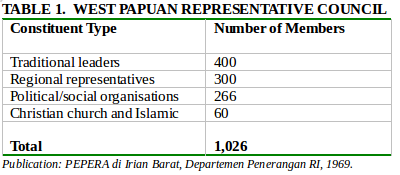
Because of the new government regulations (PP 1966) the Indonesian military was able to appoint 1,026 West Papuans of various backgrounds, namely four hundred traditional leaders, three hundred regional representatives, two hundred and sixty-six representatives of political and social organisations, sixty Christian church and Islamic representative (Table 1).
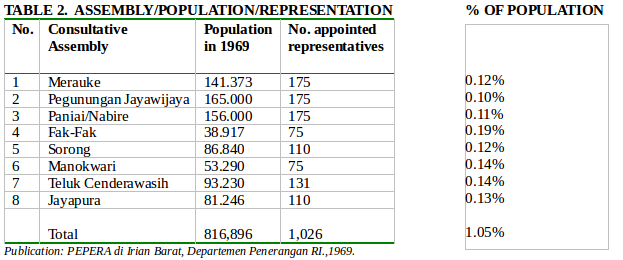
In 1969 the population of West Papua was 816,896 people. The Indonesian government created counterfeit democratic conditions by appointing representatives from the eight regencies to ‘vote’. 175 people represented 141,373 people (0.12%) from Merauke regency; 175 people represented 165,000 (0.10%) people from Jayawijaya highland regency; 175 people represented 156,000 (0.11%) people from Paniai/Nabire regency; 75 people represented 38,917 people (0.19%) from Fak-Fak regency; 110 people represented 86,840 people (0.12%) from Sorong regency; 75 represented 53,290 (0.14%) from Manokwari regency; 131 represented 93,230 (0.14%) from Teluk Cenderawasih regency; 110 represented 81,246 (0.13%) from Jayapura regency (Table 2).
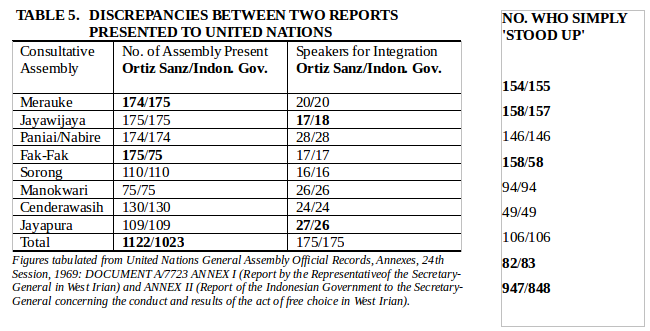
The system of ‘voting’ during the Suharto period in Indonesia – and accepted by the United Nations for the Act of Free Choice in West Papua – was called musjuwarah. This entailed several representatives in each Assembly standing up to be asked questions by the representative of the Government of the Republic of Indonesia, and in so answering proclaim the Republic of Indonesia, its constitution, its flag, and its government; one country extending from Sabang to Merauke. Then a government official told the other Assembly members to stand up if they agreed. Of the 175 representatives in the Merauke Assembly, only twenty spoke in favour of integration; of the 175 representatives in the Jayawijaya Highland Assembly, only eighteen spoke; of the 175 representatives in the Paniai/Nabire Assembly, twenty-eight spoke; of the 75 representatives in the Fak-Fak Assembly, seventeen spoke; of the 110 representatives in the Sorong Assembly, sixteen spoke; of the 75 representatives in the Manikwari Assembly, twenty-six spoke; of the 131 representatives in the Teluk Cenderawasih Assembly, twenty-four spoke; and of the 110 representatives in the Jayapura Assembly, twenty-six spoke (Table 3).
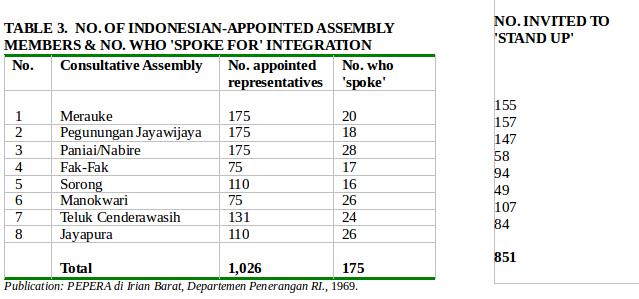
From the information collated in Table 3, it is apparent that of 1,026 Assembly members, only 175 (15%) ‘spoke for’ integration; and eight hundred, a clear majority of 86% merely stood up when they were told to by a government official.
Time factor to facilitate an evil plan
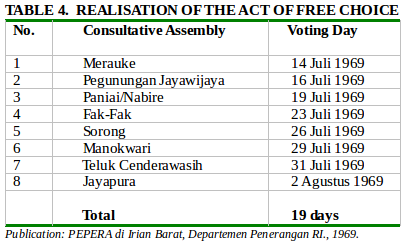
For East Timor’s referendum in 1999, the Tripartite Agreement signed on 5 May 1999 by Indonesia, Portugal, and the United Nations stipulated that the ballot take place on one day, 30 August 1999. This partially foiled Indonesia’s plan to subvert and manipulate the process. The so-called referendum in West Papua in 1969 took place over a period of nineteen days (Table 4).
There are several discrepancies between the reports presented to the UN General Assembly by the Secretary-General’s Representative (Mr Ortiz Sanz) and the Indonesian Government concerning the actual numbers who ‘voted’ in the Act of Free Choice (Table 5).
Paket 5: Indonesian political party regulations, 1985
PAKET 5 are political party regulations (UU Parpol), legislated in 1985, based on government regulations of 1966; but in truth simply a tool to avoid another ‘referendum’ in West Papua.
PAKET 1 Regulation No. 1/1985 enforced a general election in Indonesia.
PAKET 2 Regulation No. 2/1985 created a People’s Consultative Council, a Legislative Assembly, and Provincial Assemblies.
PAKET 3 Regulation No. 3/1985 arranged two political parties, namely the Development Friendship Party (PPP) and the Indonesian Democracy Party (PDI); and a party for technocrats and civil servants (GOLKAR).
PAKET 4 Regulation No. 5/1985 legislated that in the United States of Indonesia Republic the referendum system was not known, and therefore not valid.
PAKET 5 Regulation No. 8/1985 arranged social organisations.
The implications of PAKET 5 for West Papua are as follows:
PAKET 1 permitted Indonesia to capitalise on the results of the Act of Free Choice in 1969 and also to prevent another referendum by calling a general election in Indonesia.
PAKET 2 created a People’s Consultative Council, an Indonesian Legislative Assembly, and Provincial Assemblies so that the Indonesian government appeared to be representative. In fact, the Indonesian military government pre-determined appointments to these bodies.
PAKET 3 created three official political parties, enabling Indonesia to claim that any organisations created by West Papuans were subversive.
PAKET 4 legislated for Indonesia’s protection against any claims that the 1969 ‘referendum’ in West Papua was fraudulent; and against any attempts by West Papuans to agitate for another.
PAKET 5 limited the creation of any social organisations in West Papua which might develop into grass roots political organisations.
By the ‘reforms’ of 1985 the Indonesian government was able to annul the political rights of West Papuans, whether they be human rights, democractic rights, or pertaining to the environment.
In West Papua under Indonesian governance
By the application of international law and regulations, and Indonesian national law and regulations, problems between Indonesia and the Kingdom of the Netherlands were solved. However the solutions created enormous problems for West Papuans that remain to the present day. Indonesia manipulated international law, and created more of their own regulations, in order to secure a neo-colonial presence in West Papua. Since then a lot of West Papuan people have been incarcerated in Indonesian prisons, a lot have been exiled (especially to the island of Java) and kidnapped and tortured. Approximately 400,000 West Papuans have been killed. Rape (of civilians’ and guerillas’ wives and daughters) is common; gardens, homes, churches, and village clinics are randomly destroyed, and West Papuans have been robbed of their property and wealth (Tindakan Tidak Manusiawi Atas Warga di IRJA Agar Dihentikan, Suara Pembaharuan, 1 Juni 1998:8; Stop Action of Human Rights for Irianese, Voice of Reform, 1 June 1998:8).
Indonesian government projects have destroyed West Papua’s natural environment. Illicit logging in Jayapura, Yapen Waropen, and Merauke regencies has destroyed one hundred thousand hectares of jungle trees that are then used for plywood. Thousands of hectares of natural sagu has been destroyed around Sorong and Jayapura; the ecology has been destroyed around the Freeport mine in Timika; agricultural cycles are continually interrupted if not destroyed.
The Indonesian government’s national program, based on Indonesian revolutionary history, should not have been applied to West Papua. This program, based on Pancasila, is not appropriate for West Papuans. However because it has been forced on West Papuans for so long, the people have become one dimensional in their thinking. I will explain ‘monodimensional’ by referring to a psychological concept called ‘reifikasi’, or brain-washing, which causes people to become unimaginative, and causes them to accept certain attitudes and applications with little or no critical analysis. For example, people with ‘reifikasi’ think that:
1. A good President can only come from Java;
2. A good President has to have a military background;
3. A defence force with a double function (dwifungsi) protects all aspects of society.
4. A big Indonesian Army will annihilate resistance in East Timor, Aceh, and West Papua.
5. It is impossible for East Timor, Aceh and West Papua to achieve independence.
But does a good Indonesian President have to come from Java? The Indonesian nation was actually destroyed by two presidents from Java: Ir. Soekarno who claimed he was guided by a democratic ideology, and Soeharto who led according to Pancasila principles. The third President, Professor BJ Habibie, who did implement some democratic measures, is, in fact, from Sulwesi.
Does a good President have to have a military background? Ir. Soekarno, Professor Habibie, Dr Abdurahman Wahid, and Megawati Sukarnoputri all have civilian backgrounds.
Does the Indonesian military protect Indonesian society? Dwifungsi ABRI (the Army’s dual function) is an institutionalised component of the Indonesian political system, and is meant to ensure the nation is protected and develops. However ABRI has destroyed Indonesia, and continues to do so.
Has the Indonesian army stopped resistance in East Timor, Aceh, and West Papua? The Army did not solve the Indonesian nation’s problems in East Timor, Aceh, and West Papua. In fact, the Army is the problem.
Will East Timor, Aceh, and West Papua become independent? East Timor is now independent, and West Papua and Aceh will follow in due course.
Because of the condition of Reifikasi, many Indonesians and West Papuans, especially West Papuan intellectuals, lawyers, and political activists, are dead. Many West Papuans now are not autonomous thinkers, and haven’t been creative in formulating a national development.
Solving West Papua’s political situation peacefully
For thirty-seven years, West Papuans have opposed the Indonesian colonial regime, and tried to find methods to solve their political problems. Is this because the Indonesian security and defence is very strong? Or because the international community simply lets the West Papuans continue to suffer? Or is it because we struggle valiantly, but have not mounted a consistent and effective campaign for all aspects of the struggle?
I believe important parts of the struggle deserve special consideration. If we consider the links between cause and effect it can be seen that the root causes of the problem are political:
1. New York Agreement, 15 August 1962.
2. INPRES (Indonesian Presidential Instructions) 1 May 1963.
3. The Indonesian government regulations of 1966.
4. PAKET 5 political party regulations of 1985.
Some international human rights organisations, and some in Indonesia, have voiced concerns about human rights and the environment, but haven’t yet solved any problems. This is because they are investigating the effects, not the root causes, of the problem. Who was responsible for creating the causes? Why did they create the causes? How were democratically-inspired strategies subverted? What has been the effect of the subversion?
Solving the problem strategically, step by step
Discussions, Seminars and Conferences: West Papuans must have more discussions and conferences with the Indonesian government, the Indonesian people through non-government organisations, the international community, the Dutch government, the American government, and the United Nations. These will open a dialogue to help create peaceful solutions.
Approaches: West Papuan people must initiate and establish good relationships with:
1. Indonesian nationals so that they are able to understand the political rights of the West Papuans, and learn how these rights have been denied. Indonesians will thus learn how the Indonesian government system affects their rights as well.
2. Members of the international community – NGOs, governments departments and national parliaments, churches and Islamic institutions – who can help to train a team of West Papuan diplomats and arrange diplomacy tours to Europe, America, Africa, Asia and the South Pacific.
3. Communities from the South Pacific – Australia and New Zealand, Papua New Guinea, Fiji, the Solomons, Vanuatu, Samoa, Tonga, Cook Islands, Willis, Futuna, Tuvalu, Kiribati, and Nauru. These island-nations of the Pacific are important because West Papua is a Melanesian nation and can learn from, and probably rely on the support of, their Melanesian, Micronesian and Polynesian brothers and sisters. In 1947 at the South Pacfic Forum in Canberra, in which West Papuans participated, the independence quests of the Pacific nations were recognised and supported (M. Ferry Kareth, SH. Perjalanan Integrasi Wilayah Irian Barat Kedalam Negara Kasatuan Republik Indonesia Suatu Tinjauan dari Aspek Yuridis, Makalah, Bandung 27-29 April 1999). With the exception of West Papua and New Caledonia, all the Melanesian, Micronesian and Polynesian nations gained their independence after Indonesia occupied West Papua.
4. Indigenous land rights movements. Papua’s indigenous cultures are the fundamental resource of the West Papuan identity that is the root of the independence struggle. Therefore strong and enduring links should be made, and resources shared, with indigenous movements. Alliances with them is entry to a sophisticated network of international lobbyists.
Lobbying: Having successfully established these approaches, West Papuans must then advance their independence by lobbying the Indonesian government, the Indonesian people, the international community, and the South Pacific nations.
Networking: West Papua must establish a strong network with nations, organiaations, and individuals that have been lobbied. Human rights and environmental information can be shared, providing West Papuans can be helped to set up effective technology to gather and collate data.
National Independence Advocacy Commission comprised of members from NGOS from West Papua, NGOs from Indonesia, plus some NGOs from West Papua, the Protestant church, the Catholic Church, the Baptist, Pentecostal Church, Seventh Day Adventists, Islamic organisations, and intellectuals. The Commission will research and investigate human rights violations, and environmental degradation so that the link between the cause of West Papua’s problems and the effects are clearly defined and widely discussed; and aired in the appropriate Indonesian government, parliament, executive and judicial institutions.
International Advocacy Commission with a minimum of ten people from ten countries to:
Summary
Proposals
To the Indonesian Government
The Government of Indonesia should return to West Papuans their political rights and the 420,000 sq kms of land stolen from them between 19 December 1961 and on 1 May 1963.
The Government of Indonesia should avoid further humiliation of its nation, and restore the dignity of its people in the eyes of the international community, by returning to West Papuans their way of life, their property rights, their wealth, and their right to independence.
The Hon. Megawati Sukarnoputri. You are President of Indonesia, and also President of PDI-P (Partai Demokrasi Indonesia Perjuangan/Indonesian Democratic Party of Struggle). You are also the daughter of the first president, Ir. Soeharto. You clearly understand how the histories of Indonesia and West Papua were manipulated by your father, and the suffering in West Papua this manipulation has caused. You have a moral responsibility to solve the problem. This is a good time for you and your family and your country to concern yourselves with the fate of Melanesia West Papua. By doing so, you will earn the respect of all nations in the world, and future generations of Indonesians will grow in peace, love and justice.
To the Government of the Kingdom of the Netherlands
It is difficult for the Dutch government to communicate with Indonesia about the political rights of the West Papuans because of their former position as a colonial power. However, the Dutch could use their unique status to lobby (directly and indirectly) for dialogue between Indonesia, America, and the United Nations about the New York Agreement.
To the United States of America
Given that West Papuan land, sweat, tears and blood were sacrificed to the success of the United States and its allies in the Pacific campaign during World War Two; and that Indonesia’s decision to annex West Papua was influenced and supported by pragmatic American foreign policy of the late fifties and sixties, the USA must assume some responsibility for the deaths of at least four hundred thousand West Papuans who have died at the hands of Indonesian military.
Indonesia is still heavily influenced by America, so the United States is in a unique position to influence the course of the future for West Papua. America could be creating initiatives to help West Papuans re-gain the political integrity that was stolen from them. I believe that in the Americas – the home of many peoples, many NGOs, congressional members, those in the White House-there are those who have good hearts, and who want to help the West Papuans re-gain their political integrity and their human rights, a pursuit by which the Indonesians will also re-stock their sense of national dignity.
To the United Nations
The UN Secretary-General should instigate a review of the New York Agreement of 15 August 1962, and the Act of ‘No’ Choice of 1969, and cancel UN General Assembly Res. No. 2504 of 19 November 1969. By these measures West Papua would be put back on the UN agenda so that solutions can be devised based on justice and in accordance with international law.
Suggested Reading
Amnesty International. POWER AND IMPUNITY: HUMANITY RIGHTS UNDER THE NEW ORDER. London 1994.
Anti-Slavery Society for the Protection of Human Rights. WEST PAPUA: PLUNDER IN PARADISE. 180 Brixton Road, London 1990.
Australian Council for Overseas Aid. TROUBLE AT FREEPORT. Canberra 1995.
Breen, G. LET THEM BE: WEST PAPUA REVISITED. Australia-West Papua
Association, Melbourne 1993.
Budiardjo, C & Liong, LS. WEST PAPUA: THE OBLITERATION OF A PEOPLE. Tapol. 111
Northwood Road, Thornton Heath, England 1988.
Hill, H (ed). INDONESIA’S NEW ORDER: THE DYNAMICS OF SOCIO-ECONOMIC
TRANSFORMATION. Allen & Unwin, Sydney 1994.
Jamieson M. WEST PAPUA HIDDEN LAND. In “Habitat” Australian Conservation
Foundation, May 1993.
Environment Centre of the Northern Territory. UNDER THE GARUDA IN EASTERN
INDONESIA. Submission to Federal Parliament Sub-committee 1992.
Jones GW & Raharjo Y. PEOPLE LAND AND SEA: Development Challenges in Eastern
Indonesia. Australian National University, 1995.
Manning C & Rumbiak M. IRIAN JAYA: ECONOMIC CHANGE, MIGRANTS, AND
INDIGENOUS WELFARE. In Hill, H “Unity and Diversity, OUP, Singapore 1989.
Marr C. DIGGING DEEP: THE HIDDEN COSTS OF MINING IN INDONESIA. Down to
Earth (PO Box 213, London SE5 7LU, UK) & Minewatch (218 Liverpool Road, London
N1 1LE, UK) Special Report No. 2, London 1993.
May RJ (ed). BETWEEN TWO NATIONS: THE IINDONESIAN-PAPUA NEW GUINEA
BORDER AND WEST PAPUAN NATIONALISM. Robert Brown, Bathurst 1986.
McCarthy J. ARE SEET DREAMS MADE OF THIS? TOURISM IN BALI AND EASTERN
INDONESIA . IRIP, Melbourne 1994.
Mitton RF. THE LOST WORLD OF IRIAN JARA. Oxford University Press, Melbourne 1983.
Monbiot G. POISONED ARROWS. Abacus, London 1989.
Muller K. INDONESIAN NEW GUINEA: IRIAN JAYA. Periplus, Berkeley 1990.
Nightingale. N.NEW GUINEA: AN ISLAND APART. BBC Books, London 1992.
Osborne R. INDONESIA’S SECRET WAR: THE GUERILLA STRUGGLE IN IRIAN JAYA.
Allen and Unwin, Sydney 1985.
Otten M. TRANSMIGRATION: MYTHS AND REALITIES-INDONESIAN
RESETTLEMENT POLICY, 1965-1985. Copenhagen, IWGIA Document No. 57 1986.
Petocz RG. CONSERVATON AND DEVELOPMENT IN IRIAN JAYA: A STRATEGY FOR
RESOURCE CONSERVATION. EJ Brill/WWF Leiden 1989.
Poulgrain G. THE POLITICS OF EL DORADO-FROM WEST NEW GUINEA TO IRIAN
JAYA. Hurst, London 1998.
Skephi. A COMPLETE ACCOUNT OF IRIAN. Setiakawan No. 4-5, Skephi, Jakarta 1990.
Start D. THE OPEN CAGE: THE ORDEAL OF THE IRIAN JAYA HOSTAGES.
HarperCollins, London 1997.
Wing J. THE BIRD OF PARADISE AND THE TIGER, THE IMPACT OF DEVELOPMENT
ON THE POPULATION AND ENVIRONMENT OF THE INDONESIAN PROVINCE
OF IRIAN JAYA. (Unpublished thesis) University of Sydney 1994.
