
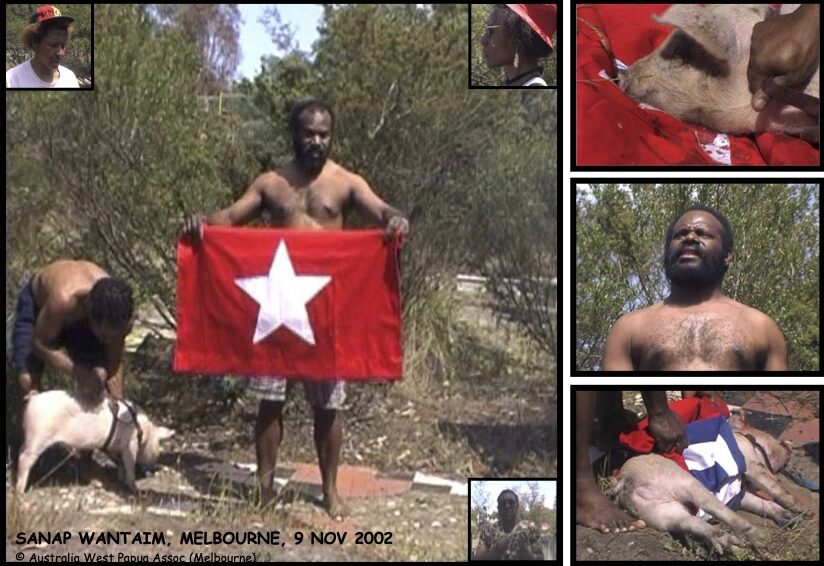
9 November 2002, Sanap Wantaim, Pipemakers Park, Maribyrnong (Melbourne)
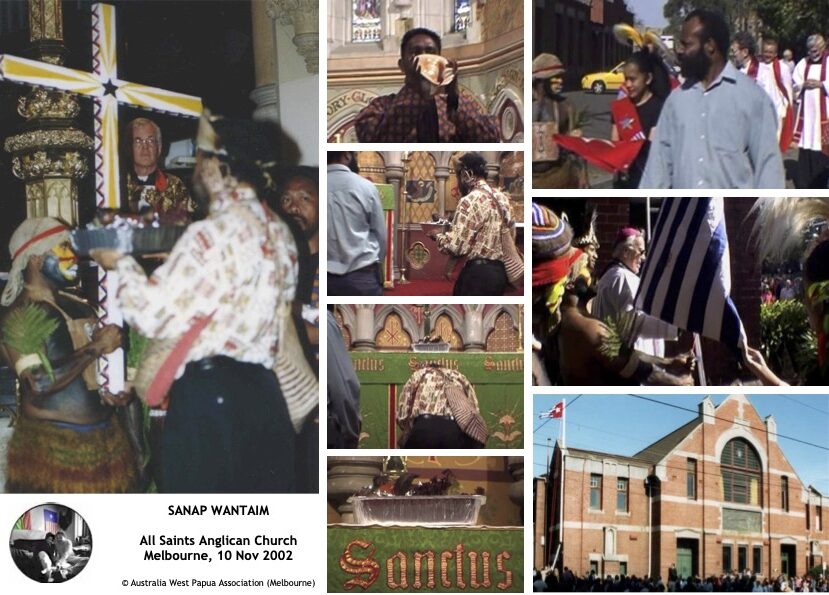
10 November 2002, Sanap Wantaim, All Saints Anglican Church, East St Kilda (Melbourne)
On 9 November 2002 in a quiet Aboriginal space on the banks of the Maribyrnong River a pig was ritually sacrificed by modern Melanesian chiefs on the traditional lands of the Wurundjeri Woi Wurrung people. The next day, a Catholic bishop, some monks, and a bevy of Anglican priests joined Melanesian cultural and political leaders in All Saints Anglican Church in St Kilda for a ceremony to highlight the human sacrifice that takes place every day in West Papua. It was the first time that Australian Catholics and Anglicans worked together in support of West Papua’s quest to cast off its cloak as a south-east Asian colony. It is also the first time that Melanesians from the Pacific have so publicly and so stylishly demonstrated their support.
The two-day ceremony, ‘Sanap Wantaim’ (PNG pidgin for “Stand up, Together”) was a carefully woven weave of Melanesian principles, West Papuan traditions, and Christian practices, organised by five mature-age students from Fiji, Vanuatu and Papua New Guinea, and Jacob Rumbiak, West Papua’s popular ‘minister for independence’ who has lived in Melbourne since he escaped from Cipinang prison in Jakarta in 1999.
The ceremony in the church required complex negotiations between the Melanesians, the Australian Catholic Bishop (Hilton Deakin), an Aboriginal Anglican priest (Janet Turbie-Johnston), and the parish priest of All Saints (Fr Ramsay Williams). In this context, the classic virtues of ‘justice, peace and love’ were chosen as the corner stones of the ceremonial prayer for the forty-year freedom struggle. Ultimately there were processions, songs, amazing music, words from scripture and other places, cultural dances, religious and spiritual blessings. The ceremony concluded with the West Papuans Morning Star flag raised over the intersection of Dandenong Road and Chapel Street; a moment of high political symbolism, because Dandenong Road (Highway No.1) at Cape York in Far North Queensland is just a short boat ride from West Papua. Finally, in the church warden’s back yard, there was a Mumu, a classic Melanesian feast of pork and taro, wrapped in banana leaves and cooked in the earth over hot stones.
The title of the ceremony and the themes chosen by the Melanesian team were “Land, Liberty, Solidarity: Celebrating Melanesian’s sacred relationship with their land and the virtues of justice, peace, and love”. JACOB RUMBIAK:The people of West Papua are suffering. Please help them, bring them out from suffering to peace, bring them from unjustice to justice, bring them from unlove to love. ANASTASIA SAI (PNG): The Word of God was spoken and our land was formed. The Word of God who called forth our tribes… Let this Word guide our steps with wisdom…The Cross. In West Papua and the other Melanesian societies, a person without land is like a drift wood, one who has no roots and no direction. Land gives a sense of identity and belonging. It is from the land that the Melanesian people find sustenance and life. The head of the pig now presented in this procession represents the land that God made and gave to each of our tribes ….
Sanap Wantaim for West Papua (10-min video, Jen Hughes)
All Saints Church All-male Choir
In 1881, the Argus newspaper reported “As some Australians never walk a yard if a horse can be captured, so at All Saints’ no word is enunciated that can, by any dexterity, be sung, chanted or intoned”. The all-male choir’s contribution to Sanap Wantaim was John Rutter’s motet The Lord is my Shepherd for choir, piano, and oboe (played by Jeff Dodd from the Melbourne Symphony Orchestra). It was an appropriate choice, because the Psalm – an ode to man’s enduring relationship with God – is also West Papua’s national verse. The choir also presented an a capella rendition of The Three Little Pigs composed by church organist and choir master Hugh Fullarton. This included segments of the popular ABC recording of Tri pela lik lik pik made in the Port Moresby studio in the sixties, as well as the choir singing the pigs and wolf’s dialogue, and 3D animations of the big issues: the deception, the greed, the will to survive. The inclusion of this classic fable was apt, because Jacob Rumbiak’s pig, Yabon, only became an important symbol for West Papua’s liberation struggle in Melbourne because of Prime Minister Howard’s foolish instruction to the media and universities not to address issues pertinent to West Papua.
Three little pigs in Tok Pisin (10-min video)
https://www.youtube.com/watch?v=H61y75G0A24
“I still own this 45 size record from my early childhood living in Port Moresby PNG from 1969 to 1973. We used to howl laughing listening to this in later life. So gorgeous. Thanks for uploading this for the masses to enjoy too” (Tony Goodwin, youtube comment).
Risking the Sacred, ABC-RN, 5 Oct 2003 (60-min audio)
“Maybe you have been moved to throw your lot in behind an indigenous people seeking independence or a fledgling nation struggling to achieve economic development. You have your activist tool kit out and you are ready to take up the cudgels. But pause a moment, suggests this Encounter – and ask first, what are your obligations as an activist to the worldview of the people whose cause you want to argue … This story of Sanap Wantaim begins with a person, perceptions and a pig” (Producer Margaret Coffey).
Risking the Sacred, ABC-RN, 5 Oct 2003, Transcript (PDF)
https://www.abc.net.au/listen/programs/encounter/risking-the-sacred/3453960
Sanap Wantaim: Melanesian West Papua (1500-word essay)
https://arena.org.au/sanap-wantaim-melanesian-west-papua/
Louise Byrne, Arena Magazine 62, December 2002. Louise is completing a dissertation on ‘West Papua: tensions in the transition to independence’ at the Globalism Institute, RMIT University.
Forum: Kindling the Sacred in political discourse & activism
Kindling the Sacred in political discourse and activism, Transcript
Kindling the Sacred in political discourse and activism was a forum hosted by the Globalism Institute at RMIT University for an invited audience of academics, street politicians, church workers, ngos, meat-eaters, bean-munchers, mainstream and alternative journalists, and a bevy of thoughtful but demanding Melanesians – who had been asked to prepare for an ‘interactive hypothetical’ by reflecting on the ways they pursue social change. The forum began with a ten-minute visual recapitulation of a religious ceremony for West Papua that was led by Melanesian cultural custodians in All Saints Anglican Church on 10 November 2002.
“It was absolutely intended that people would talk in a full bodied, embodied and difficult way about what it meant for them to be religious or to be spiritual, and a distinction was attempted to be drawn between the institution of the church and being spiritual which was an important distinction which was easy to make from an academic distance but was one hard for the people inside it. But when we got to the forum itself what we found is that people became overawed not by the spiritual but by the situation of talking politically about the spiritual. It was a very interesting process because we had set it up with the intention that the opposite could happen and a lot of people from Pacific islands were invited but they found it harder to tell their stories than anybody else” (Professor Paul James, Director of the Globalism Institute at RMIT University).
Participants in Sanap Wantaim, 9-10 November 2002
Larry Walsh (Kulin Nation). Rev. Janet Turbie-Johnston (Gundjitamara nation). Peter Heffendon (Pipemakers Park). Morris Kaloran (Vanuatu). Jacob Rumbiak and Fransiscus Uweng (West Papua). Barbara Carl, Jennifer Mondia, Anastasia Sai, Chris Kia, and the Gabb family (Papua New Guinea). Fr Ata and Aggie & Freeman Podarua (Solomon Islands). Robert & Lupe Wolfgramm (Fiji). Tommy, Ati, Shanti, Tania Latupeirissa; Nico Leatomu (Maluku). General Genamy (Karen Liberation Struggle). Inotoli Zhimoni (Nagaland). Fr Ramsay Williams, Mark Stevens, Hugh Fullarton, All Saints Choir (All Saints Church). Jeff Dodd (Melbourne Symphony Orchestra). Fr Stephen Giblin. Ben Hjorth & the cast of Tri pel lik lik pig (St Michael’s Grammar School). Bishop Hilton Deakin (Catholic Archdiocese of Melbourne). Matthew Beckmann OFM (Fransiscan Friar). Rita Hayes RSM (Religious Sisters of Mercy). Sr Genevieve & Joan Power (Presentation Sisters). Kel Dummet, Nick Chesterfield, Louise Byrne (Australia West Papua Association-Melbourne). Jen Hughes & Jeff Karutz (Media Circus Video Documentary Productions). Ashley Gilbertson (Photographer).
